
Walk into almost any process plant in India — a dairy, a paper mill, a dye house, a rice mill, a refinery — and look up. Somewhere overhead runs an insulated pipe, and inside it is steam. The technology is three hundred years old. It has outlived line shafts, DC drives and a dozen "replacements". That is not nostalgia. It is physics, four times over.
Reason 1 — one kilogram carries an enormous amount of heat
When steam condenses on a heat-transfer surface, it releases its latent heat — the energy that was invested to turn water into vapour. At 3.5 kg/cm²g (a typical process pressure) that is about 507 kcal for every kilogram of steam.
Compare the alternative: circulate hot water and let it cool by 10 °C, and each kilogram gives you 10 kcal. The kilogram of steam delivered roughly fifty times more. That is why a DN80 steam line can do the work of a very large hot-water loop, and why steam equipment is compact for the duty it performs.
Reason 2 — pressure sets temperature, exactly
Saturated steam obeys a lock that no other common heating medium offers: at each pressure there is exactly one condensing temperature. Hold a cooking jacket at 3.5 kg/cm²g and every square centimetre of that jacket sits at about 148 °C — top, bottom, first minute, last minute. There is no hot end and cold end, no gradient scorching the product near the inlet.
Want 158 °C instead? Raise the pressure to 5 kg/cm²g. Temperature control becomes pressure control — one valve, one measurement, self-regulating across the whole surface. The lesson What is steam? shows the full curve.
Reason 3 — it moves itself
Steam flows from the boiler to the furthest user because of its own pressure difference. No circulating pumps on the supply side, no flow balancing between users — open a valve anywhere on the network and steam arrives. A hot-oil or hot-water system needs a pump running (and drawing power) every hour the plant heats anything.
Reason 4 — it is only water
The working fluid costs almost nothing, is not flammable, does not degrade, and — as culinary or clean steam — can touch food and pharma processes. A leak is a cloud, not a fire or an effluent problem. Make-up is a water-treatment plant, not a tanker of specialty fluid.
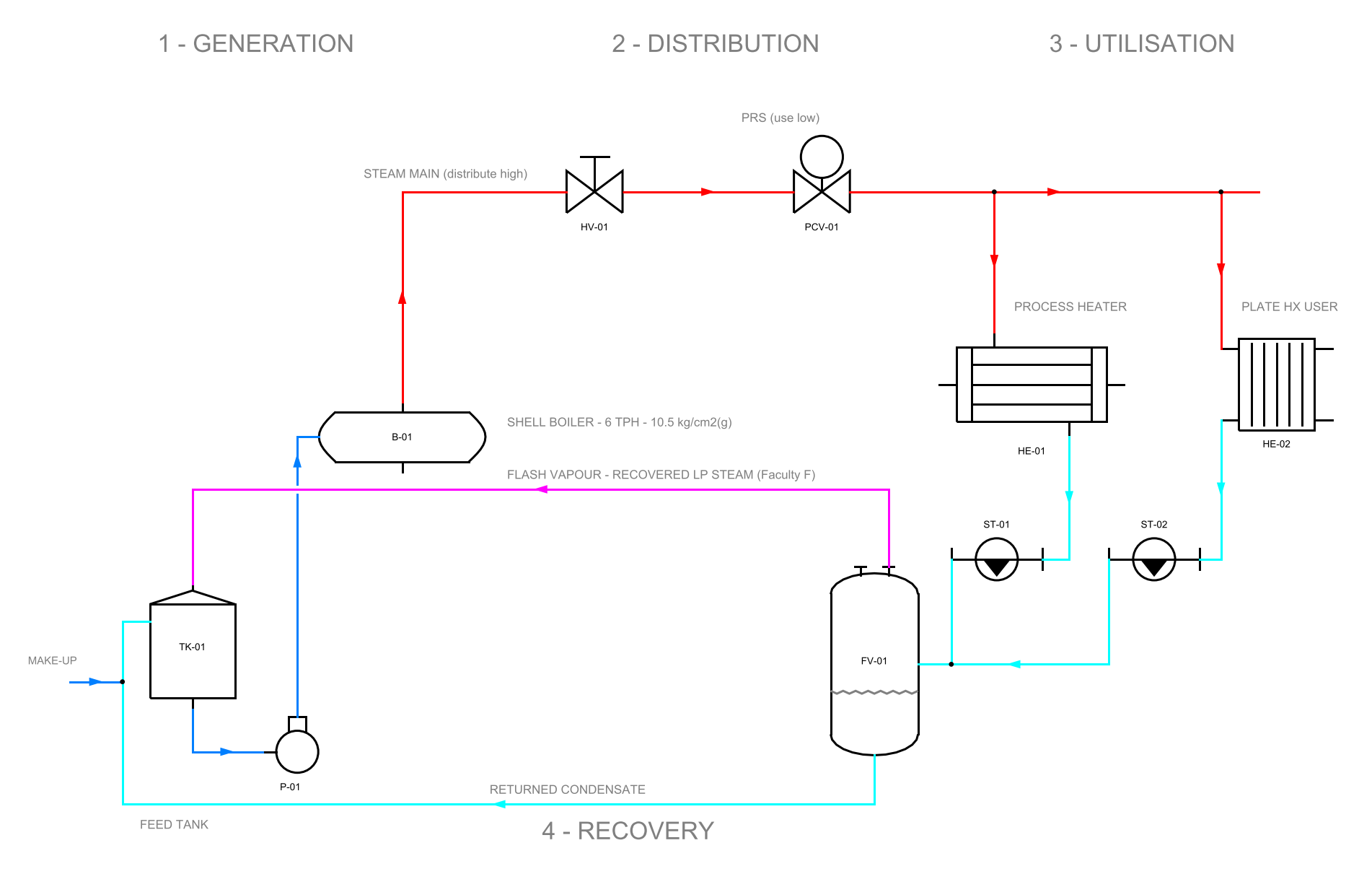
Throughout this academy we audit one imaginary plant: a 6 TPH husk-fired shell boiler at 10.5 kg/cm²g feeding a food-processing line — a dryer, a jacketed vessel, and a hot-water duty. Today, just the scale of it:
Call it ₹21–22 lakh of fuel a month — almost always the largest single utility bill in the plant. Every lesson that follows is about where those rupees go.
Where steam honestly does not fit
Above roughly 180–200 °C, saturation pressure climbs steeply — 250 °C needs about 40 kg/cm², with all the piping and IBR consequences that follow. That territory belongs to thermic fluid (hot oil at near-zero pressure) or, increasingly, other carriers — the faculty Hot Water & Thermic Fluid makes the comparison properly. Steam also loses its shine on very small, scattered, intermittent loads, and in any plant that lets its condensate run to drain: the economics of steam assume you keep the loop closed.
Three questions tell you whether steam runs a plant's economics:
- What share of total production cost is boiler fuel? (In steam-heavy sectors, often the largest controllable cost.)
- How much condensate actually returns to the feed tank — measured, not assumed?
- Who last checked the steam-to-product ratio against its best-ever value?
- Latent heat is the workhorse: ~500 kcal/kg against 10 kcal/kg for a 10 °C water loop.
- Pressure sets temperature — control one and you have controlled the other.
- Steam needs no supply pump; its own pressure moves it.
- The medium is water: cheap, safe, food-compatible.
- The economics assume condensate comes back. No return, no advantage.
The unit "horsepower" is steam marketing. James Watt needed to sell mine owners an engine they could compare with what they already had — horses walking a whim gin — so he measured a strong horse's sustained work and rated his engines in multiples of it. The sales unit outlived the horses, the mines and the engines.
FAQ
When is steam the wrong choice?
Three honest cases. Above roughly 180–200 °C, saturation pressure climbs brutally — 250 °C needs about 40 kg/cm² — so that territory belongs to thermic fluid (E6 settles the choice properly). Very small, scattered, intermittent loads rarely repay a boiler house. And a plant that lets condensate run to drain has already given away the advantage — steam economics assume a closed loop.
Why doesn't a steam system need a supply pump?
The boiler pressure itself pushes steam to every user — open a valve anywhere on the network and steam arrives, self-distributed by pressure difference. A hot-water or hot-oil loop needs a circulating pump drawing power every hour the plant heats anything. The pumping bill returns only on the condensate side, and even there gravity and flash pressure do much of the work.
Why is steam heating so uniform across the surface?
Because saturated steam condenses at exactly one temperature for its pressure. Hold a jacket at 3.5 kg/cm²g and the whole surface sits at about 148 °C — no hot end near the inlet, no cold end at the outlet, first minute to last. Temperature control becomes pressure control: one valve, one measurement, self-regulating everywhere at once.
What does running a boiler actually cost per month?
Fuel dominates. Our practice plant — 6 TPH at 10.5 kg/cm²g, 20 hours a day at 75% efficiency on husk at an indicative ₹2,500/t — burns about 29 t/day, roughly ₹72,000/day or ₹21–22 lakh a month. In steam-heavy sectors that is usually the largest controllable cost in the plant, which is why this academy keeps returning to where those rupees go.
Is a steam leak dangerous the way a fuel or solvent leak is?
Not in kind — the medium is water, so a leak is a cloud, not a fire or an effluent problem, and that safety is one of steam's four founding advantages. It is still money escaping at pipeline pressure, every hour of every shift: C9 turns hole sizes into rupees per year.
Check yourself
Five quick questions on this lesson. No marks, no records — the score is for you.