
A boiler is a kettle that never empties: water leaves as pure steam, and everything the water carried — salts, silica, treatment chemicals — stays behind and concentrates. Left alone, the concentration climbs until the boiler foams, primes and scales. Blowdown is the deliberate bleed that holds the line, and because every litre of it leaves at boiler temperature, it is also a fuel stream. This lesson is about bleeding exactly enough, and keeping the heat.
Why boilers must bleed
Feedwater is never pure. Even softened water carries dissolved solids — measured as TDS, in ppm — and the boiler concentrates them relentlessly: 1 kg of steam out means the solids of 1 kg of feed stay in the drum. Too high, and the water surface froths; froth breaks into the steam space and the boiler primes, throwing water and its solids into the main (the carryover of lesson A9's wet steam). Silica and hardness residues bake onto hot surfaces as scale. Shell boilers typically hold the line around 3,000–3,500 ppm; water-tube plant runs far tighter. Your boiler maker's figure — not folklore — sets the limit.
How much: one honest fraction
At steady state, solids in = solids out:
blowdown % = feed TDS ÷ (boiler TDS limit − feed TDS) × 100
Practice plant: softened make-up blended with returned condensate gives feed at about 300 ppm; the limit is 3,500 ppm. Blowdown = 300 ÷ 3,200 ≈ 9.4% — call it 9% — so at the typical 5,000 kg/h steaming rate (the 6 TPH boiler's real average across the day — lesson B3's derate arithmetic) the boiler must bleed roughly 470 kg/h of boiler water. Notice the lever hiding in the formula: feed TDS sits on top. Raise condensate return (condensate is nearly distilled water) and feed TDS falls almost in proportion — at 80% return the same boiler bleeds ~5%, not 9. Condensate recovery projects earn twice: once in lesson D6's heat, and again here in halved blowdown.
What the bleed costs — and how to keep most of it
Each kilogram of blowdown leaves with hf = 188 kcal at 10.5 kg/cm²g. At 470 kg/h that is ~88,000 kcal/h — about 2% of the boiler's fuel — plus treated water down the drain. Recovery is standard practice, in two stages:
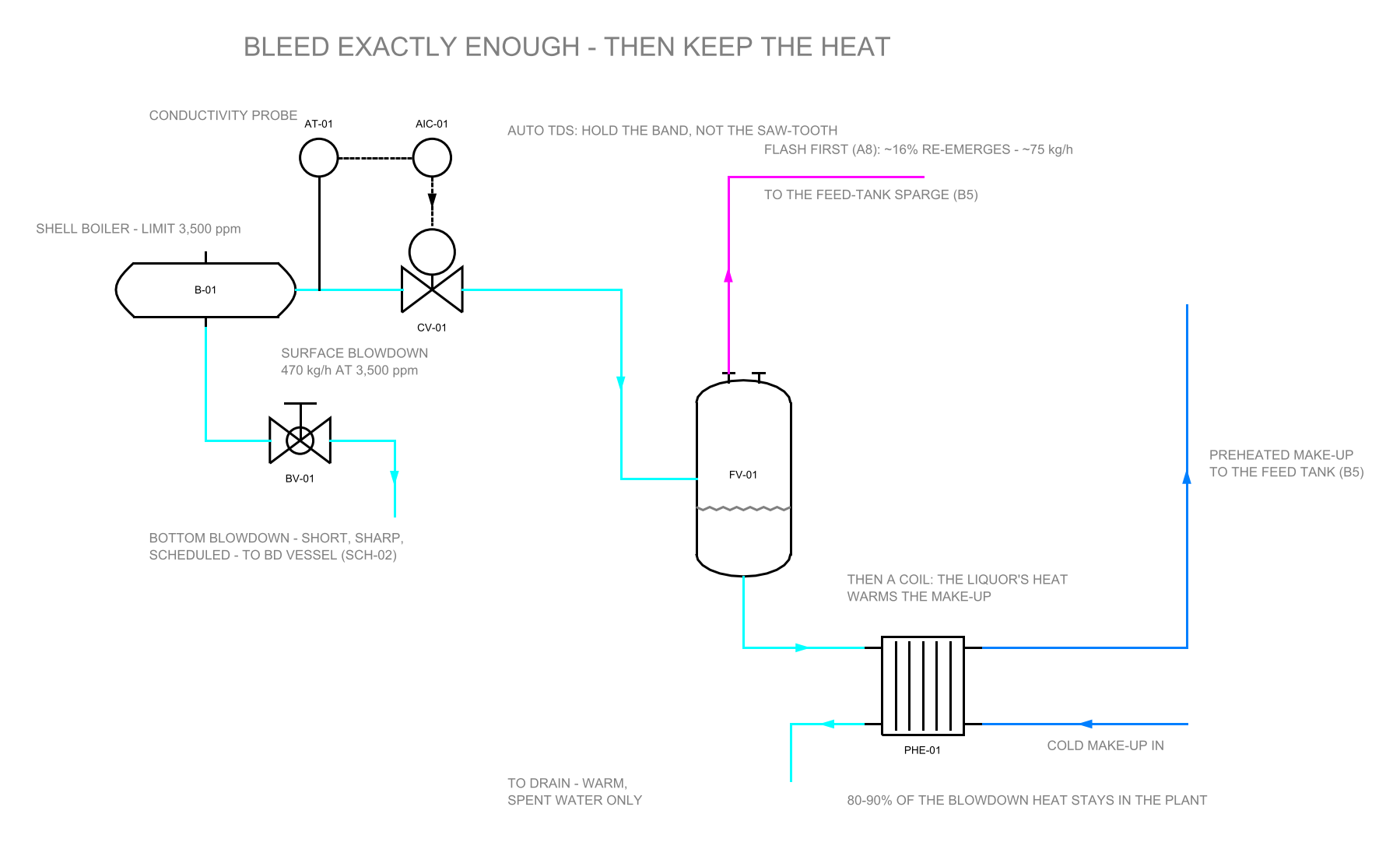
Flash first. Drop the blowdown into a flash vessel at the feed-tank's pressure: lesson A8's arithmetic says ~16% of it re-emerges as clean low-pressure steam — ~75 kg/h here — piped straight to the feed tank sparge (lesson B5). Then a coil. The remaining ~395 kg/h of hot liquor still holds ~100 °C-grade heat; run it through a simple coil or plate exchanger warming the cold make-up water on its way to the tank. Between the two, 80–90% of the blowdown heat stays in the plant, and the drain receives warm, spent water instead of live fuel.
Continuous, bottom, and automatic
Two different jobs share the name. Continuous (surface) blowdown bleeds from just below the water surface, where TDS concentrates — this is the controlled stream the formula sizes, and the one worth automating: a conductivity probe and a modulating valve hold the boiler within a tight band instead of the manual routine's saw-tooth (over-bled mornings, over-limit nights). Bottom blowdown is a short, sharp, once-a-shift blast from the mud drum to eject settled sludge — seconds long, done with the boiler quiet, never left cracked open. An automatic TDS system typically repays itself within a season on the over-blowdown it eliminates; the practice plant's manual 9%-by-habit was measured at 12% before the probe went in.
- Measure boiler TDS honestly (cooled sample or conductivity with the right factor) at least daily; log it. The saw-tooth on the chart is money.
- Work the formula with your own feed TDS — plants that never re-checked after a condensate project routinely over-blow by half.
- Blowdown lines that run hot to an open drain are the plant confessing wasted fuel. Touch the pipe.
- Bottom blowdown: short and scheduled. A cracked-open bottom valve is an unmetered leak of boiler water at full pressure.
- Blowdown % = feed TDS ÷ (limit − feed TDS). Feed TDS is the lever; condensate return pulls it.
- Blowdown leaves at boiler temperature: ~2% of fuel at the practice plant before recovery.
- Recover twice — flash to the feed tank, liquor heat to the make-up. 80–90% of the heat is keepable.
- Surface blowdown controls TDS (automate it); bottom blowdown ejects sludge (short, sharp, scheduled).
Boiler-water limits were written in explosions. Nineteenth-century inspectors, puzzling over drums that burst below their design pressure, kept finding the same culprits: scale-blanketed plates running hundreds of degrees hotter than the water they were meant to touch, and gauge glasses reading confidently on foam. The insurance companies' answer — scheduled blowdown, water testing, and the inspector's visit — hardened into today's TDS tables. Every ppm limit in your boiler manual is a very old accident, filed for reuse.
FAQ
How do I work out my own boiler's blowdown rate?
One fraction: blowdown % = feed TDS ÷ (boiler TDS limit − feed TDS) × 100. Measure your blended feed (make-up plus condensate) honestly, take the limit from the boiler maker's manual — not folklore — and the formula does the rest. The practice plant's 300 ppm feed against a 3,500 ppm limit gives about 9%, roughly 470 kg/h at its steaming rate.
If my water treatment is good, can I stop blowing down?
No — even well-softened make-up carries dissolved solids, and the boiler concentrates them relentlessly: the solids of every kilogram of feed stay behind. What good treatment and high condensate return do is shrink the required bleed, because feed TDS sits on top of the formula. At 80% condensate return the practice plant would bleed ~5% instead of 9.
What is the difference between surface and bottom blowdown?
Two different jobs sharing a name. Continuous surface blowdown bleeds from just below the water line where TDS concentrates — it is the controlled stream the formula sizes, and the one worth automating. Bottom blowdown is a short, sharp, once-a-shift blast from the mud drum to eject settled sludge — seconds long, boiler quiet, never left cracked open.
Is an automatic TDS control system worth the money?
Usually within a season. Manual routines saw-tooth — over-bled mornings, over-limit nights — and plants habitually over-blow: the practice plant's "9% by habit" measured 12% before the conductivity probe went in. The probe and modulating valve hold a tight band, and the eliminated over-blowdown is pure fuel and treated water saved.
How much of the blowdown heat can I realistically get back?
80–90%, in two standard stages. Flash the blowdown at feed-tank pressure — about 16% re-emerges as clean low-pressure steam for the sparge (B5) — then run the remaining hot liquor through a simple coil or plate exchanger warming the cold make-up. Only warm, spent water should reach the drain; a blowdown line running hot to an open drain is the plant confessing wasted fuel.
Check yourself
Five quick questions on this lesson. No marks, no records — the score is for you.