
The boiler eats what the feed tank serves. Serve it cold, gassy water and it responds with fuel bills and pinhole leaks; serve it hot, de-gassed water and half the chemistry problems of lesson B7 never happen. Feedwater is where the condensate system, the water treatment and the fuel account all meet — one tank, three budgets.
The economics: every 6 °C is a percent
Heat fed to the boiler as hot water is heat the fuel need not supply. The practice plant's arithmetic from lesson B3: raising steam takes hg − hfeed, so every kilocalorie already in the feedwater comes off the fuel bill directly. The working rule: every ~6 °C of feedwater preheat saves about 1% of fuel. The practice plant feeds at 90 °C instead of 30 °C — sixty degrees, roughly ten percent of the fuel account, worth about ₹22 lakh a year at its ₹600/t and its ~5,000 kg/h average steaming rate. Where does that 90 °C come from? Free heat, twice over: returned condensate at ~90 °C (lesson D6) and flash steam sparged into the tank (lesson A8). The feed tank is not storage; it is the plant's cheapest heat exchanger.
The chemistry: gases that eat boilers
Raw water arrives with dissolved oxygen and carbon dioxide on board. In a hot, pressed boiler, oxygen turns electrochemical: it attacks steel at points, drilling neat hemispherical pits under blisters of rust — a tube can pinhole in a season while losing almost no average thickness. CO₂ rides out with the steam, dissolves in condensate, and returns as carbonic acid that grooves the bottom of condensate lines (lesson D6 meets the result). Cold water holds these gases tightly. Hot water cannot: solubility of both gases falls towards zero as water approaches its boiling point. That physics is the whole trick of deaeration.
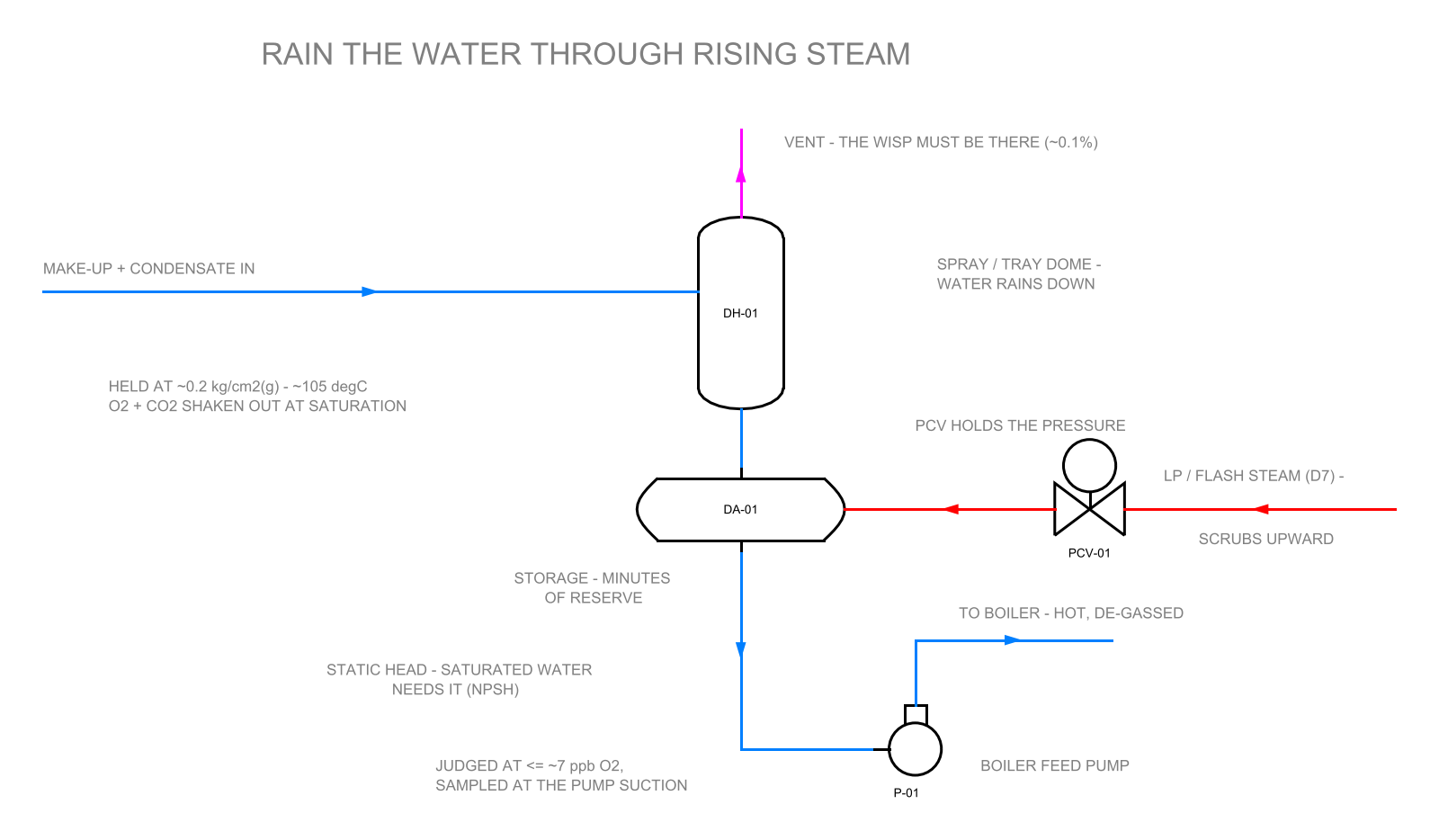
Three grades of deaeration
The hot feed tank — condensate return plus a flash-steam sparge holding 85–95 °C, atmospheric vent. Removes most of the gas load and most of the cost; this is the practice plant's arrangement, trimmed with a chemical scavenger. Right up to mid-size shell boilers with good condensate return. The pressurised deaerator — the figure above: spray/tray dome over a storage vessel at ~0.2 kg/cm²g, water held at saturation (~105 °C), oxygen down to a few parts per billion. The standard for water-tube plant, high make-up, or anywhere scavenger chemical bills grow embarrassing. Chemical scavenging — an oxygen-absorbing dose (classically sulphite for process plant) that mops the residual after thermal deaeration. It is the trim, never the main act: scavenging cold, gassy water by chemicals alone is pouring money into a physics problem.
Feed tank craft
A good feed tank returns condensate high and lets it fall (releasing its flash inside, not into the room), sparges flash steam low through a distributor, keeps a loose lid — insulated but vented, never sealed — and holds enough for 20–40 minutes of boiler demand. Watch its thermometer like a gauge: a falling feed temperature means lost condensate return or a failed sparge, and it will surface in the fuel account within the week (lesson B4's 574-kcal arithmetic moves immediately).
Prove it, don't trust it
A deaerator is judged by one number: dissolved oxygen in the water leaving it — about 7 parts per billion or better is the standard acceptance benchmark for a pressurised unit (verify the figure your deaerator maker actually guarantees). Not "the vent is steaming" or "the gauge reads 0.2" — those say it is running, not that it is working. A surprising share of deaerators that look healthy fail the number, and the usual culprits are unglamorous: worn spray nozzles, damaged trays, a mis-set vent.
The test is cheap and six-monthly: draw a sample at the feed-pump suction into a colorimetric ampoule — or an online DO meter, which turns the number into a trend — with the chemical scavenger suspended for about 48 hours first, because a generous sulphite dose will mop the sample and grade a broken machine as excellent. Chemistry must not be allowed to mask mechanics. Keep the vent honest while you are there: a fraction of a percent of the deaerator's throughput (~0.1%) leaving as a steady wisp is the price of deaeration — choked, the gases stay in; roaring, fuel is leaving through the roof. And where even the wisp offends the accountant, a small vent condenser returns its heat to the incoming make-up (lesson D7's recovery logic, pointed at the deaerator).
- Read the feed tank temperature daily. Every 6 °C lost ≈ 1% fuel. A ₹300 thermometer guards a lakh-rupee line item.
- Pitting found in tubes or the shell waterline = oxygen at work. Fix deaeration first, dosing second.
- Deaerator vent: a steady wisp of vapour is the gases leaving — it must be there. No plume = not venting; a roaring plume = wasting steam. Valve it to a whisper.
- Feed pump suction from a hot tank needs static head or the pump cavitates — if the pump rattles on hot days, the tank is telling you it sits too low.
- Book the dissolved-oxygen test twice a year: scavenger off ~48 h, sample at the feed-pump suction, ampoule or meter. A deaerator is judged at ≤ ~7 ppb — not by its plume.
- Feedwater heat is fuel: ~6 °C of preheat = ~1% off the fuel bill.
- Hot water cannot hold gas — deaeration is temperature, applied deliberately.
- Oxygen pits; CO₂ acidifies condensate. Both are cheaper to remove than to repair.
- Thermal deaeration does the work; chemical scavenging only trims the residue.
- The feed tank is the meeting point of condensate, flash and make-up — run it hot, vented and watched.
Marine engineers learnt deaeration before anyone: a ship's condenser-fed boiler recycles the same water for months, and early steamships that topped up with aerated water ate their boilers on long runs. The deaerating feed heater became standard naval practice by the 1920s — and the specification "oxygen: seven parts per billion" that modern power stations chase descends directly from what kept wartime boiler rooms afloat. Process industry inherited the vessel, the trays and the number.
FAQ
Does a small shell boiler really need a pressurised deaerator?
Usually not. A hot feed tank at 85–95 °C — condensate returned high, flash steam sparged low, loose vented lid — removes most of the gas load, and a chemical scavenger trims the rest. That is the practice plant's own arrangement. The pressurised deaerator earns its cost on water-tube plant, high make-up, or wherever the scavenger chemical bill has grown embarrassing.
The deaerator vent blows a little steam all day. Isn't that waste?
A steady wisp is the machine working — that is the freed oxygen and CO₂ leaving, and it must be there. No plume at all means the vent is shut and the gases are going to the boiler instead. A roaring plume is genuine waste. Valve it to a whisper and check it on every round.
Why does the feed pump rattle on hot days?
Cavitation. Hot water sits close to its boiling point, so the pump needs static head above its suction to keep the water liquid at the impeller eye — and a tank mounted too low runs out of margin exactly when the water is hottest. The cure is height (or a cooler tank, which costs fuel): if the rattle comes with temperature, the tank is telling you it sits too low.
What does dissolved oxygen actually do inside a boiler?
It attacks steel at points rather than evenly — neat hemispherical pits under blisters of rust, drilling a tube to pinhole in a season while the average wall barely thins. That is why pitting found at the waterline or in tubes says "fix deaeration first, dosing second": the chemistry lesson (B7) starts where the gas removal stops.
The feed tank is running cooler than last month. What should I check?
The two free-heat inlets: condensate return (a new leak, a failed trap station or a diverted line — D6) and the flash-steam sparge (blocked distributor, closed valve). Every 6 °C lost is about 1% on the fuel bill, so a falling thermometer surfaces in the fuel account within the week.
Check yourself
Five quick questions on this lesson. No marks, no records — the score is for you.