
Some plants do not have a steam demand — they have steam weather: autoclaves gulping tonnes for ten minutes, presses cycling, sterilisers opening on the hour, and a boiler asked to survive it. Lesson B3 showed why a boiler answers sudden demand badly. The steam accumulator is the honest fix: a battery for steam, charged in the lulls, discharged into the peaks. This lesson is how it works and when it pays.
The problem: peaks a boiler cannot chase
A shell boiler's firing rate ramps in minutes, but a demand spike arrives in seconds — and the boiler's first response is unhappy: pressure sags, the water swells and foams, and carryover rides into the main (lesson A9). Chase the peaks with firing and the burner cycles wastefully; size the boiler for the peaks and it idles oversized — with the poor part-load efficiency of lesson B4 — for the rest of the shift. When the peak-to-average ratio passes roughly two, the boiler is the wrong tool for the peak.
The trick: store water, not steam
Steam itself stores terribly — vg at 10.5 kg/cm²g is 0.173 m³/kg, so a vessel of pure steam holds almost nothing. But saturated water is energy-dense, and lesson A8 taught the release mechanism: drop the pressure over hot water and it flashes to steam instantly. An accumulator is exactly that — a pressure vessel mostly full of water, held at boiler pressure. In the lulls, surplus boiler steam sparges in and condenses, charging the water hotter and the vessel fuller. When demand spikes, the plant draws from the vessel and its pressure falls — and the whole water mass boils spontaneously, delivering steam at whatever rate the flash physics allows, which is far faster than any grate or burner. The boiler, behind it, steams serenely at average load.
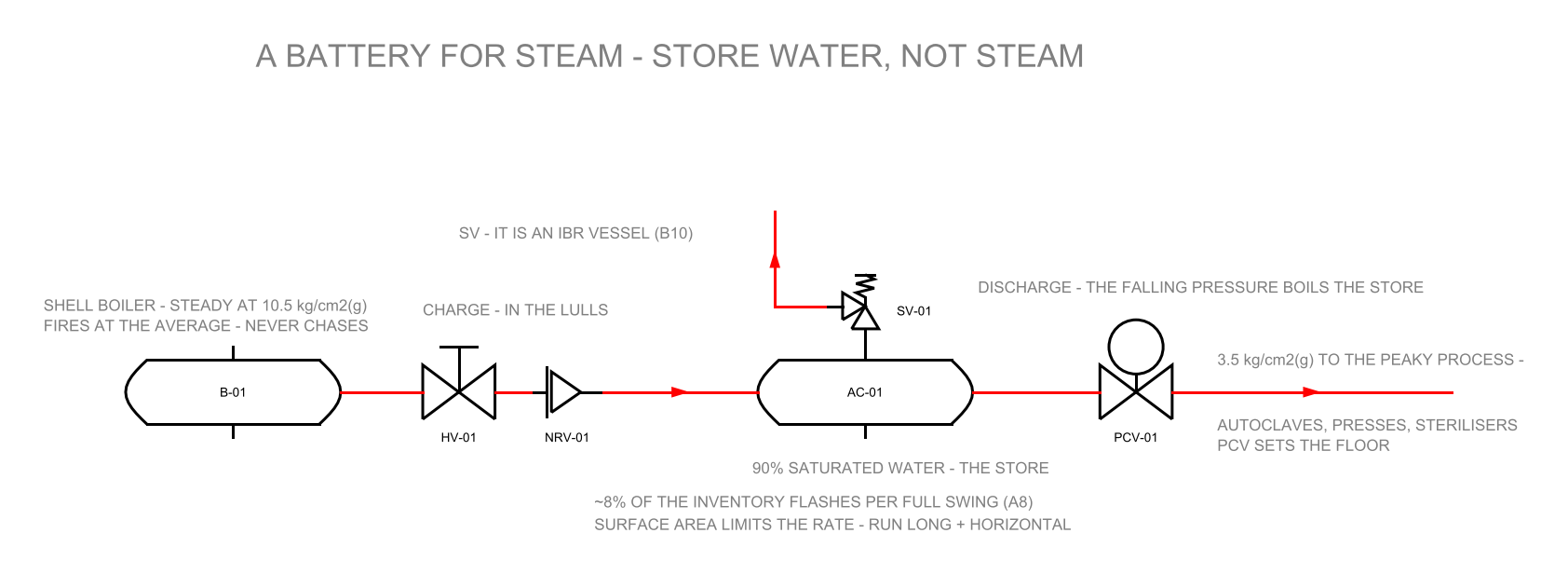
The sizing arithmetic
How much steam does a vessel hold? Lesson A8's flash formula, applied to the whole inventory. Swinging between the boiler's 10.5 kg/cm²g (hf = 188) and the process floor of 3.5 kg/cm²g (hf = 148, hfg = 507):
steam released per kg of water = (188 − 148) ÷ 507 ≈ 0.08 kg — call it 8%
A 10 m³ accumulator, 90% full, holds about 7,900 kg of saturated water (density ~0.88 at 185 °C) and therefore delivers roughly 620 kg of steam per full swing — enough to carry a 2,500 kg/h spike for a quarter of an hour with the boiler contributing only its average. Two design honesties: the discharge rate is limited by the water surface area (violent flashing lifts droplets — vessels are sized long and horizontal for surface, not just volume), and the delivered steam arrives at the falling pressure, so the process must genuinely accept the lower end of the swing. A process that insists on full pressure at the peak needs a different answer.
When it pays — and when it doesn't
The accumulator earns its steel when peaks are short, tall and frequent — AAC and composite autoclaves, corrugators, batch sterilisers and dye vessels, rubber presses. It buys: a smaller boiler bought and licensed, steady firing at honest efficiency, an end to pressure-sag quality problems, and carryover peace. It does not pay where the "peak" is really a sustained higher load (that is simply undersized boiler plant), where the process cannot tolerate the pressure swing, or where floor space genuinely cannot host a vessel. The alternative everyone tries first — oversizing the boiler — pays lesson B4's part-load penalty every hour, forever, to solve a problem that occurs minutes a day.
- Chart steam flow (or pressure) for a full shift before deciding anything. The peak-to-average ratio and peak duration are the whole case, and memory exaggerates both.
- Pressure sagging on every autoclave door, burners hunting, boiler priming on the peaks — the accumulator symptom set. Confirm with the chart.
- An accumulator is an IBR pressure vessel: design, registration and inspection follow lesson B10's rules — budget the paperwork with the steel.
- Check the swing honestly with the process team: what is the true minimum pressure the peak can run at? That number sizes the whole vessel.
- Steam stores badly; saturated water stores superbly and flashes on demand — the accumulator stores water.
- Charge in the lulls at boiler pressure; discharge on the peaks by letting pressure fall. The boiler sees only the average.
- Yield per swing = (hf₁ − hf₂)/hfg₂ — the A8 formula scaled to tonnes: ~8% of the inventory on a 10.5→3.5 swing.
- Pays when peaks are short, tall, frequent — and the process accepts the pressure swing. Otherwise fix the boiler sizing instead.
The accumulator's patron is the Swedish engineer Johannes Ruths, whose 1910s vessels let modest boilers drive ferocious paper-mill and power peaks — "Ruths accumulator" remains the textbook name. The most charming descendants were the fireless locomotives: a locomotive that was only an accumulator, charged from a stationary boiler, then shunting all shift through chemical works and munitions plants where a firebox was unthinkable. Some served European factories into the 1980s — a steam engine with no fire, running entirely on lesson A8.
FAQ
Why not just buy a bigger boiler and forget the peaks?
Because the oversized boiler pays lesson B4's part-load penalty every hour, forever, to solve a problem that occurs minutes a day — radiation loss doubling at half load, burners cycling through purge losses. The accumulator lets a smaller boiler steam serenely at average load while the vessel absorbs the weather. Past a peak-to-average ratio of roughly two, the boiler is simply the wrong tool for the peak.
Why does an accumulator store water rather than steam?
Because steam stores terribly: at 10.5 kg/cm²g a kilogram occupies 0.173 m³, so a vessel of pure steam holds almost nothing. Saturated water is the energy-dense form — and dropping the pressure over it makes the whole mass boil spontaneously. The vessel is ~90% water on purpose; the steam space is just the delivery hall.
How much steam does a vessel actually deliver per swing?
The flash fraction times the inventory. Swinging 10.5 → 3.5 kg/cm²g releases (188 − 148) ÷ 507 ≈ 8% of the stored water as steam — so a 10 m³ vessel, 90% full (~7,900 kg), yields roughly 620 kg per full swing, enough to carry a 2,500 kg/h spike for a quarter of an hour. The deeper the allowed pressure swing, the bigger the yield — which is why the process's true minimum pressure sizes the whole vessel.
Will the process notice it is running on the accumulator?
It will see falling pressure — that is the discharge mechanism, not a defect. The steam arrives at whatever pressure the swing has reached, so the process must genuinely accept the bottom of the swing (3.5 kg/cm²g in the worked case). A process that insists on full pressure at the very peak needs a different answer, honestly stated before anyone orders steel.
Does an accumulator come under IBR?
Yes — it is a pressure vessel holding saturated water at boiler pressure, so design, registration and annual inspection follow B10's rules. Budget the paperwork with the steel, and involve the Inspectorate before fabrication, not after.
Check yourself
Five quick questions on this lesson. No marks, no records — the score is for you.