
Steam is not the only way to move heat around a plant — and for a band of duties between roughly 90 and 130 °C, it is often not the best. Pressurised hot water (PHW) — a closed loop of water held above atmospheric pressure so it can run hotter than 100 °C without boiling — quietly serves some of the best-run process sites in the country. This lesson is the honest comparison: what a PHW loop is, where it beats live steam, and where steam remains untouchable.
The idea: pressure buys temperature, the loop keeps everything
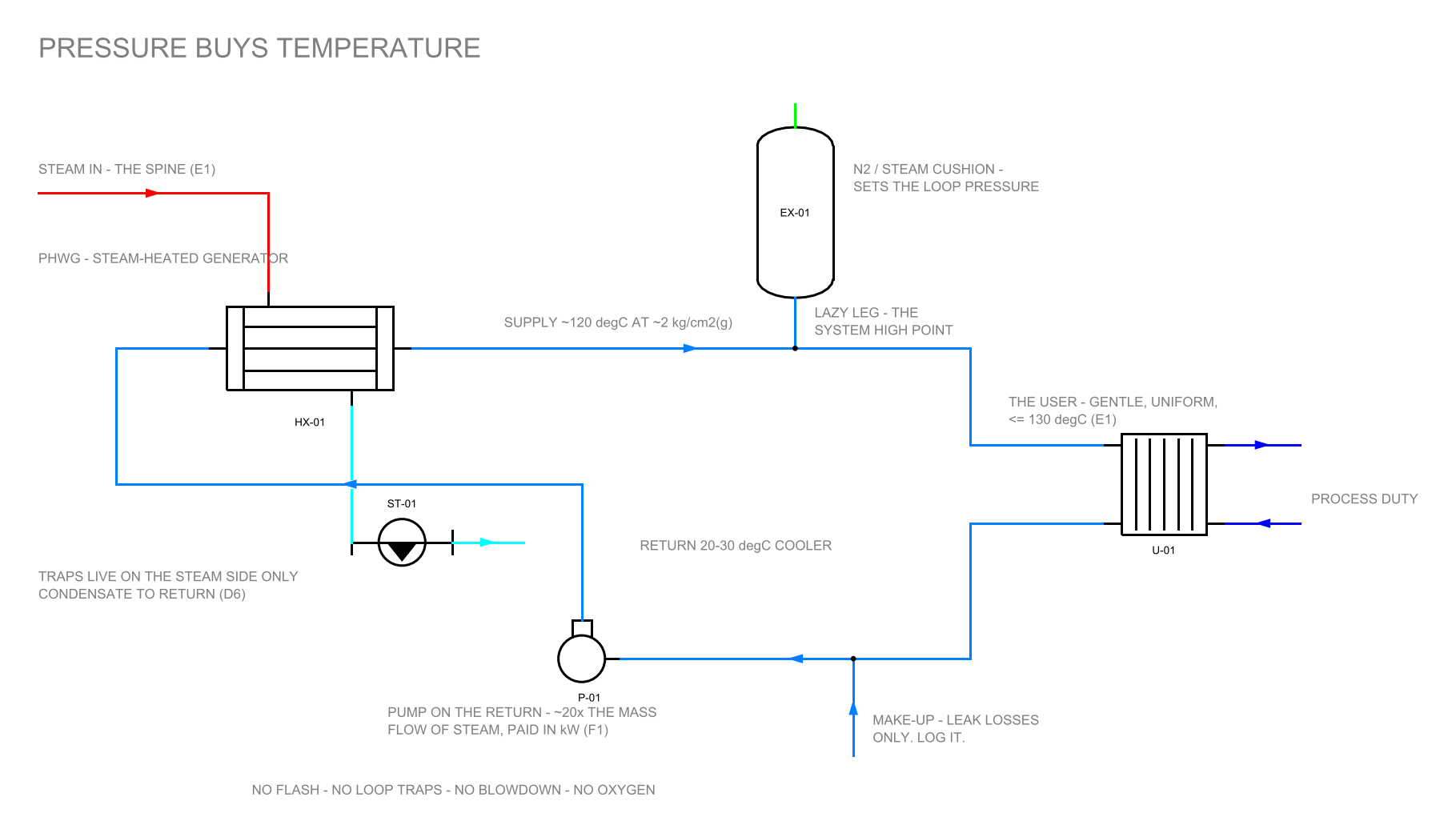
Water at atmospheric pressure caps at 100 °C. Hold the same water at 2 kg/cm²g and it can run to ~130 °C as liquid; the saturation curve of lesson A3 read as a permission slip. A PHW system is a closed circuit: a generator (steam-heated exchanger, hot-water boiler, or waste-heat source) lifts the loop water to supply temperature, pumps push it around the users, and it returns cooler — typically a 20–30 °C drop — to be reheated. Pressurisation comes from a nitrogen or steam cushion, or simple static head. Nothing leaves: no flash, no traps, no condensate to chase (the entire Faculty D drainage saga simply does not exist), no make-up beyond leak losses, no blowdown because nothing concentrates (lesson B6 also cancelled).
What PHW does better
Losses collapse. The plant sheds the vent plumes, trap losses and flash arithmetic of a steam system — distribution losses on a tight PHW loop run at a fraction of an equivalent steam network's, which is why district heating worldwide runs on hot water, not steam. Control gets gentle. Water's temperature can be trimmed in fractions of a degree by mixing (three-way valves), where steam control means pressure steps. Duties that hate overshoot — delicate foods, chemical baths, drying profiles, jacketed reactors below 130 °C — get measurably better product on PHW. Uniformity. Every point of a heater sees nearly the same water temperature (a 20 °C ΔT versus steam's all-or-nothing 148 °C wall), so surface hot spots disappear — the reason plywood and laminate presses moved their platens to hot water and hot oil generations ago. Corrosion quiets down. A closed, deaerated loop reuses the same oxygen-starved water forever; lesson B5's pitting chemistry has nothing to eat.
What steam still does better
Density of delivery: a kilogram of steam hands over ~500 kcal; a kilogram of loop water with a 25 °C ΔT hands over 25. The same duty needs roughly twenty times the mass flow — pumped, through fatter-feeling pipes, on electricity (lesson F1 prices pumping; PHW pays it in kW where steam pays in traps and flash). Temperature ceiling: above ~130–150 °C, the pressure needed to keep water liquid climbs steeply and the loop's vessels go heavy — steam's territory begins, and above that, thermic fluid's (lesson E3). Instant punch: condensing steam delivers enormous flux into a cold load — batch processes that want violence (retorts, sterilisers, big warm-ups from cold) suit steam's latent-heat avalanche, not a 25 °C ΔT stream. Direct use: anything that wants steam as a substance — DSI (D2), humidification, sterilisation, vacuum ejectors — has no PHW equivalent.
The conversion question, honestly
Most PHW debates in India are not greenfield — they are "should this 3.5 kg/cm²g steam duty become hot water?" The screen: is the duty genuinely ≤130 °C? Is its condensate return today poor or contaminated (a bad return system strengthens the PHW case — the loop forfeits nothing)? Is temperature uniformity worth money in the product? Does the site have several such duties that one loop could serve? Four yeses make a study worth commissioning; the practice plant's 90 °C hot-water duty and its jacketed vessel both sit in exactly this window, which is why lesson E6's matrix exists. And the halfway house is real: many plants run a steam spine (generation and big duties) feeding PHW sub-loops (the gentle duties) through one exchanger — lesson D9's instantaneous route, scaled up.
- List every duty running below 130 °C on reduced steam. That list is the PHW candidate register, and most plants have never written it.
- On any existing PHW loop: check the cushion pressure against the highest loop temperature — an under-pressurised loop cavitates pumps and flashes at high points (lesson C5's physics in new clothes).
- Closed loop means closed: log make-up water. A loop that "needs topping up weekly" is leaking somewhere it also loses oxygen discipline.
- Compare carriers on delivered ₹/1000 kcal (B2's method) including pumping power — not on fuel alone.
- PHW = water above atmospheric pressure so it can carry 90–130 °C as liquid, in a closed loop that loses almost nothing.
- Wins: distribution losses, fine control, surface uniformity, corrosion peace. No traps, no flash, no blowdown.
- Loses: ~20× the mass flow (pumped), a hard temperature ceiling, no latent-heat punch, no direct-steam duties.
- The steam-spine + PHW-sub-loop hybrid is often the adult answer.
The world's biggest heating systems chose water long ago: district heating — Copenhagen, Stockholm, Moscow, Seoul — moves gigawatts through cities as pressurised hot water, having largely abandoned steam mains decades back for exactly this lesson's reasons (losses, control, safety, corrosion). New York's famous steam system, born in 1882, is the grand exception that proves it: kept steam partly because a city cannot retrofit its basements, it remains a working museum of Faculty C and D — traps, drainage, hammer and all — under the streets of Manhattan.
FAQ
How can water stay liquid at 130 °C without boiling?
Pressure. Water boils only when its vapour pressure equals the pressure on it, so holding the loop at about 2 kg/cm²g lets the same water run to roughly 130 °C as calm liquid. It is the saturation curve of A3 read as a permission slip — the cushion (nitrogen, steam or static head) simply keeps the permission in force.
Does a hot-water loop need steam traps, flash recovery or blowdown?
None of the three. A PHW loop is closed: nothing evaporates, so there is no flash; nothing condenses out of a vapour, so there are no traps to select, test or lose; and nothing concentrates, so there is no blowdown. That whole layer of Faculty D work — and its losses — simply does not exist on the water side.
Is pressurised hot water cheaper to run than steam?
Often, inside its 90–130 °C band — but count honestly. PHW sheds trap losses, flash and vent plumes, and pays instead in pumping electricity, because each kilogram carries only ~25 kcal against steam's ~500. Compare carriers on delivered ₹/1000 kcal by the method in B2, with pumping power included, not on fuel alone.
My loop needs topping up every week. Is that normal?
No — closed means closed. Make-up should cover leak losses only, and a loop that wants water weekly is leaking somewhere, which also means it is drinking fresh oxygen and losing the corrosion peace that is one of PHW's quiet advantages. Log the make-up; a rising trend is a finding, not housekeeping.
Which of my steam duties are worth converting to hot water?
Run the four-question screen: is the duty genuinely at or below 130 °C? Is its condensate return today poor or contaminated? Is temperature uniformity worth money in the product? Are there several such duties one loop could serve? Four yeses justify a proper study — and remember the halfway house: a steam spine feeding PHW sub-loops through one exchanger is often the adult answer.
Check yourself
Five quick questions on this lesson. No marks, no records — the score is for you.