
Every lesson in this Academy prices steam by the tonne — but a plant that never weighs its steam is pricing folklore. Metering turns the steam system into an accountable utility: which department uses what, whether the project saved what it promised, and where tonight's steam went. This lesson covers the two meters that matter in Indian practice, the installation rules that decide whether they tell the truth, and the step from measuring kilograms to accounting energy.
The two workhorses
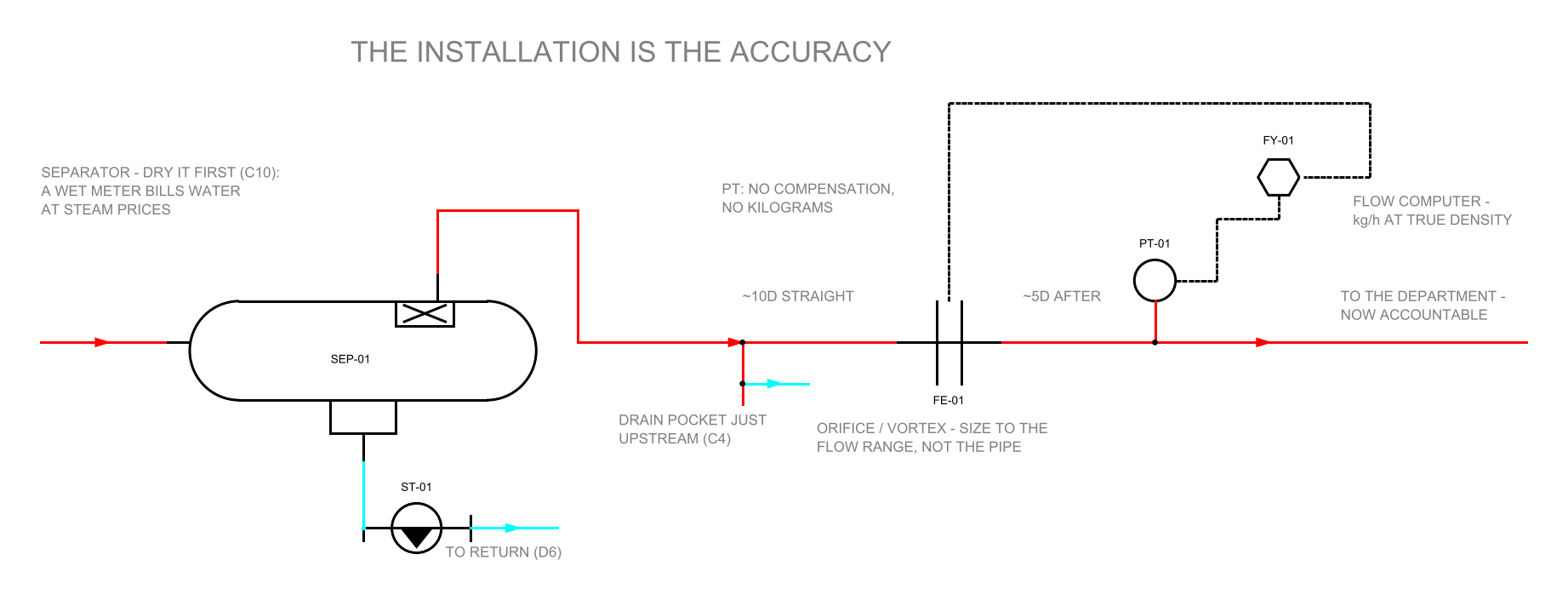
The orifice meter — a precision hole in a plate, measured by the pressure drop across it. Rugged, cheap, repairable with a spanner, understood everywhere — and honest about its limits: flow follows the square root of the differential, so a 4:1 flow range spans a 16:1 differential range, and below about a quarter of full flow the reading fades into noise. Fine for steady loads (a boiler main at constant duty); frustrating on swinging ones. Its plumbing has one rule of its own: the two impulse lines each carry a small condensing pot mounted at exactly equal heights, so both legs present identical water columns to the transmitter — and those sensing lines get blown down on a schedule (annually at the very least), because a choked leg does not fail obvious, it reads fiction with confidence. The vortex meter — a bluff bar in the flow sheds vortices whose frequency counts the velocity. Turndown of 10–15:1, no square root, no impulse lines to choke — the modern default for consumer branches with real load swings. Its honest limit sits at the bottom: below a minimum velocity the shedding stops and the meter reads a confident zero, so size the meter body to the flow range, not the pipe (a DN80 meter in a DN100 line, swaged in, is normal and correct — lesson C3's "right looks small" yet again).
Mass needs pressure: the compensation rule
Both meters sense velocity or volume — but steam is sold and burned by the kilogram, and the kilograms in a cubic metre swing with pressure (vg, lesson A5). A meter calibrated for 7 kg/cm²g reads ~10% wrong at 6 — pressure sag alone fakes a "saving". Real steam metering therefore includes pressure (and for superheat, temperature) compensation: a transmitter feeding the flow computer so every reading is converted at actual density. The audit question for any existing meter is one line: where is its pressure signal? No compensation, no kilograms — just optimistic volume. And upstream of everything: dry steam. A meter fed wet steam counts water as steam at steam prices; a separator ahead of the metering run (lesson C10) is part of the meter.
Installation: where truth is won
Meters read swirl, disturbance and water as flow. The rules that keep them honest: straight lengths — typically around ten diameters clear upstream and five downstream (more after double bends; the vendor table is law); drainage — a drain pocket (lesson C4) just upstream, because a slug of condensate through any meter is both a false reading and a hammer blow (lesson C5); orientation and tappings per the book — steam orifice impulse lines have a right and a wrong geometry, and a plugged or flooded impulse line is the classic slow lie; and location with intent — one meter on the boiler main gives the plant total (and, against fuel, a live efficiency check on lesson B4); one per major department turns steam from overhead into an accountable cost, which changes behaviour faster than any poster campaign.
From kilograms to energy
Steam accounting's final step prices what the kilogram carries: flow × enthalpy, netted against returned condensate — the true kcal delivered per department (lesson F1's stack, measured instead of estimated). Modern flow computers do this arithmetic natively; the discipline is keeping their pressure, temperature and condensate inputs honest — the meter's arithmetic is only as good as lesson B4's instrumentation hygiene. Savings claims stand on this: measure before, measure after, same meters, stated period — the M&V habit lesson F8 formalises. A project "verified" by fuel bills alone in a plant with swinging production has proven only the weather.
- Inventory existing meters with three questions each: pressure-compensated? straight lengths honoured? drained upstream? Most Indian plants fail at least one on the first walk.
- Cross-check the boiler main meter monthly: steam ÷ fuel = evaporation ratio, which lesson B2 predicted (~4.2 on the practice plant's husk). Drift means the meter or the boiler is lying — both are worth knowing.
- Buying: size vortex meters to flow range, demand the compensation package, and put the money saved on exotic meters into correct installation instead.
- Before any efficiency project: baseline with the meters you will use for the after-reading. Verdicts need identical witnesses.
- Orifice: rugged, √ΔP, happy at steady loads. Vortex: 10–15:1 turndown, needs minimum velocity, the branch-duty default.
- No pressure compensation, no kilograms. Wet steam bills water at steam prices — dry the run.
- Straight lengths, drainage, correct tappings: the installation is the accuracy.
- Meter the main for truth, the departments for behaviour, and every savings claim for lesson F8's discipline.
The orifice plate earned its authority the institutional way: decades of joint research by engineering societies through the early twentieth century measured thousands of plates into standard tables, so that two engineers on different continents drilling the same hole could trust the same coefficient without a calibration lab. That is why the orifice — technologically the humblest meter on the market — still anchors custody-transfer measurement worldwide: not because it is clever, but because it is the most thoroughly known object in flow engineering. In measurement, provenance beats novelty.
FAQ
Orifice or vortex — which meter for my line?
Match the meter to the load's behaviour. A steady duty like a boiler main suits the orifice: rugged, cheap, repairable with a spanner. A consumer branch that swings wants a vortex: 10–15:1 turndown with no square-root fade. The orifice's honest limit is the bottom quarter of its range; the vortex's is a minimum velocity below which it reads a confident zero — so size it to the flow range, not the pipe.
Our steam meter shows a saving but nothing changed. How?
Check the pressure first. Both meter types sense volume or velocity, and the kilograms in a cubic metre swing with pressure — a meter calibrated for 7 kg/cm²g reads about 10% wrong at 6. A sagging header fakes a "saving" all by itself. The one-line audit for any meter: where is its pressure signal? No compensation, no kilograms — just optimistic volume.
Why did the vendor supply a DN80 meter for our DN100 line?
Because they sized it correctly. A vortex meter needs a minimum velocity to shed vortices at all; a line-size body on a modest flow spends its life below that threshold, reading zero with great confidence. A smaller body swaged into the line keeps the velocity in the working band — correct looks small, here as at the pressure-reducing station.
Do I really need a separator before the metering run?
Yes — treat it as part of the meter. A meter fed wet steam counts water as steam at steam prices, flattering consumption and corrupting every ratio built on it. Dry steam in, a drain pocket just upstream, the vendor's straight lengths honoured: the installation is the accuracy.
How do I check the boiler main meter is telling the truth?
Divide monthly steam by monthly fuel. That evaporation ratio should sit near what the fuel arithmetic predicts — about 4.2 on the practice plant's husk (B2). If the ratio drifts, either the meter or the boiler is lying, and both are worth knowing about the same week.
Check yourself
Five quick questions on this lesson. No marks, no records — the score is for you.