
Lesson A8 proved the resource: the practice plant's dryer condensate alone flashes 465 kg/h of perfectly good low-pressure steam, worth ₹18–19 lakh a year — currently whistling from a vent. This lesson is the engineering that captures it: the vessel, its sizing, the matching of supply to a consumer, and the honest checklist that decides whether a flash project pays or disappoints.
The system in one sentence
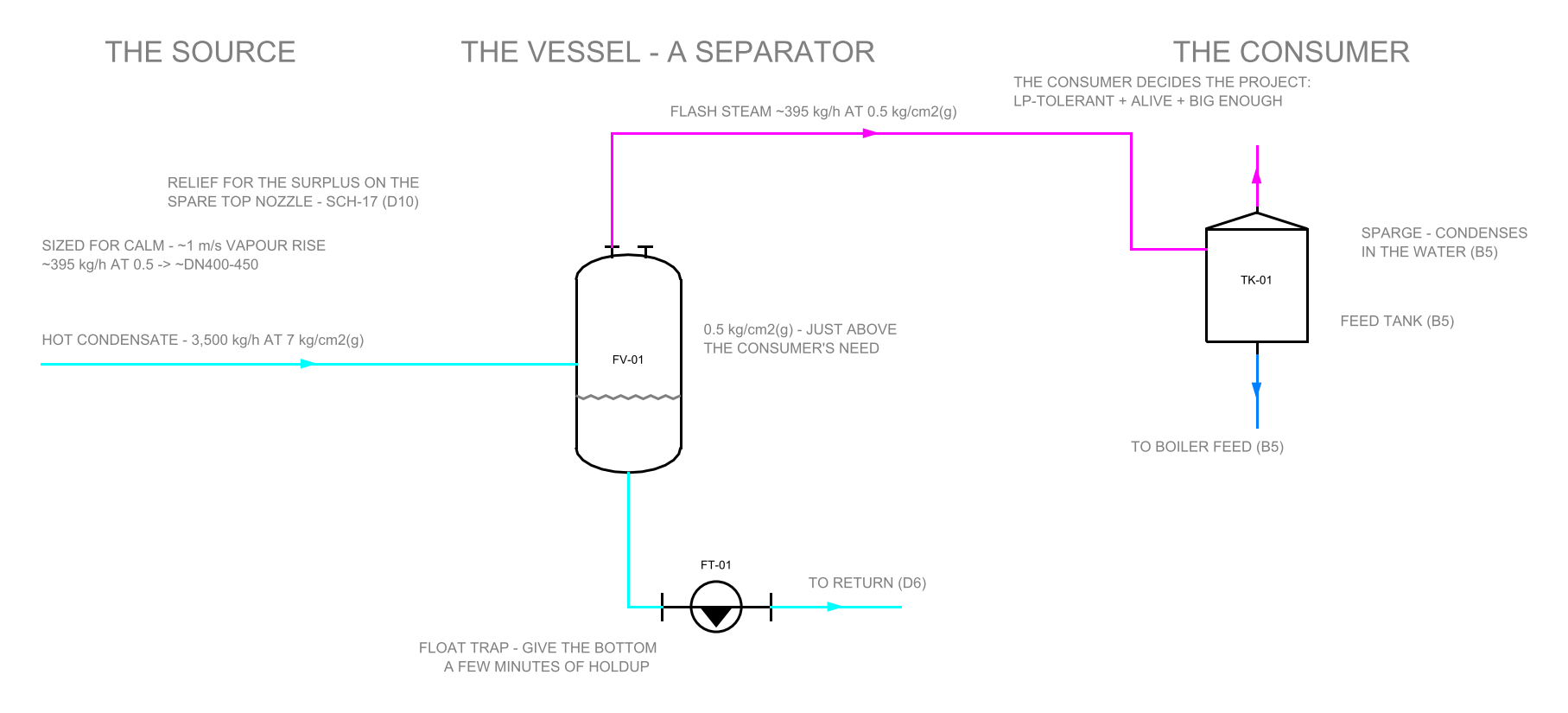
Route hot condensate into a flash vessel held at a chosen lower pressure; the A8 fraction of it re-evaporates and leaves the top as clean LP steam to a consumer, while the remaining liquid leaves the bottom through a float trap to the condensate system (lesson D6). Three design decisions follow: the flash pressure, the consumer, and the vessel size.
Decision one: the flash pressure
The vessel's pressure is a lever with two ends. Flash low and you harvest the most steam (the A8 formula rewards a big hf drop) — but LP steam is fat steam (vg!) and must find a consumer content with low temperature. Flash high and the steam is more useful but scarcer — and the condensate leaves hotter, still carrying flashable heat. The practical answer: flash to just above the pressure your chosen consumer needs. The classic sweet spot is 0.5 kg/cm²g for a feed-tank/deaerator consumer — low enough to harvest well, high enough to push itself through a sparge (lesson B5).
Decision two: the consumer — the make-or-break
Flash steam has no storage patience: it is made the moment condensate arrives and must condense somewhere the same moment. A flash project succeeds or fails on this matching, so audit like this: does the consumer accept low-pressure steam (feed tank sparge, deaerator, hot-water generation, LP coils, air-heater preheat rows)? Is it alive whenever the flash supply is (a feed tank is — it is why it is the default consumer; a day-shift-only duty against a continuous flash source wastes half the harvest)? Is it big enough (a consumer smaller than the supply vents the excess — fit a small relief-to-vent and accept it, or find a second consumer)? The practice plant's harvest — ~395 kg/h once the vessel is held at 0.5 kg/cm²g; the atmospheric vent's 465 kg/h included the last half-kilo of pressure the sparge now keeps — finds a natural home in its feed tank, which lesson B5 already runs at 85–95 °C on exactly this kind of free heat — completing a loop three lessons in the making.
Decision three: the vessel — sized for calm, not volume
A flash vessel is a separator, and its diameter is set by vapour rise velocity: slow enough that droplets fall back rather than ride out with the steam — the working band is around 1 m/s superficial. The practice plant's ~395 kg/h at 0.5 kg/cm²g — 11.3% of the 3,500 kg/h, against A8's 13.3% to atmosphere — at vg ≈ 1.16 m³/kg is ~460 m³/h = 0.13 m³/s of vapour: at 1 m/s that needs ~0.13 m² of cross-section — a vessel of roughly DN400–450, about a metre tall with tangential or baffled inlet, level-trapped at the bottom. Give that bottom a few minutes of liquid holdup, so the trap sees steady water rather than slugs. Note what did not size it: condensate flow, pressure, or enthusiasm. Undersized flash vessels deliver wet steam and re-import lesson A9's problems into the very system meant to be the improvement.
Does it pay? The honest screen
Three lines answer it. Harvest: the A8 fraction × condensate flow × running hours × B2's ₹-per-kg — the practice plant's ~₹16 lakh/yr at 0.5 kg/cm²g (of the ₹18–19 lakh its vent was losing to atmosphere; the difference is the pressure the sparge needs). Cost: vessel + pipework + trap + controls; flash projects are civil-works-light and typically land inside a one-year payback when a consumer already exists. The spoiler check: if there is no honest consumer — nothing that can drink LP steam whenever it flows — stop, and spend the same money on lesson F5's alternatives instead (recompressing the flash to a useful pressure is the thermocompressor's whole career — lesson F4). A flash vessel venting its harvest is the same waste, one flange later.
The third route: condense the vent
Between "matched consumer" and "recompress" sits a humbler option the screen above should not skip. When no consumer can drink the flash whenever it flows — and motive steam for recompression (lessons F4/F5) is not on offer either — condense the vent instead of watching it: a small heat exchanger mounted on the flash vessel or vented receiver, cooled by the incoming make-up water, turns the plume into preheated make-up on its way to the feed tank (lesson B5). The latent heat comes home at the cost of one modest exchanger and two pipe runs; where make-up flow is reasonably steady, paybacks typically land inside a year — a smaller harvest than a true consumer, and far better than the sky.
Which route fits also depends on how the flash arrives. Non-modulating sources — steady continuous processes — make a steady flash that is easy to match to a consumer. Modulating sources — temperature-controlled batch equipment — make a flash that swings with load, defeats tight matching, and suits the forgiving condenser best: make-up water does not care whether the plume comes steady or in gusts.
- Stand at the condensate receiver vent at full production: a hard, continuous plume is the site survey. Ten minutes, no instruments.
- List LP-steam consumers with their pressure and hours honestly — the feed tank first, always. Matching beats maximising.
- Check trap types upstream: flash recovery raises the back pressure traps discharge against — lesson D1's stall chart may need redrawing for equipment that was marginal.
- Size the vessel by vapour velocity (~1 m/s), never by "the drum we have lying in the yard" — the yard drum is how flash projects earn bad reputations.
- Flash to just above the consumer's pressure; 0.5 kg/cm²g to the feed tank is the classic pairing.
- The consumer decides the project: LP-tolerant, co-scheduled, big enough. No consumer, no project — recompress instead (F4/F5).
- Vessel diameter comes from ~1 m/s vapour rise — it is a separator, not a tank.
- The practice plant's number: ~395 kg/h harvested at 0.5 kg/cm²g ≈ ₹16 lakh/yr — of the 465 kg/h (₹18–19 lakh) the vent was losing — home to its own feed tank.
Paper mills were flash recovery's proving ground: a paper machine's dryer section is dozens of steam-heated cylinders in cascading pressure groups, each group's condensate flashing into the next lower one, the lowest feeding a condenser or thermocompressor — an entire orchestra of A8 played at machine scale since the mid-twentieth century. Walk any modern Indian paper machine and its "steam and condensate system" drawing is mostly flash vessels; the industry simply refuses to vent what it can cascade. Every smaller plant's single flash vessel is that philosophy, bought one drum at a time.
FAQ
How do I know whether my plant has a flash recovery project in it?
Stand at the condensate receiver vent at full production. A hard, continuous plume is the survey — ten minutes, no instruments. Then put a number on it with the flash fraction from A8: fraction × condensate flow × running hours × your steam cost. The practice plant's vent was hiding ₹18–19 lakh a year.
What pressure should the flash vessel run at?
Just above what your chosen consumer needs — the pressure is a lever with two ends. Flash low and you harvest the most steam, but it is bulky, low-temperature steam; flash high and the steam is more useful but scarcer. The classic sweet spot is 0.5 kg/cm²g feeding the feed tank or deaerator: low enough to harvest well, high enough to push itself through a sparge.
Can I store flash steam for when I need it?
No — flash steam has no storage patience. It is made the instant condensate crosses the pressure drop and must condense somewhere the same instant, which is why the consumer decides the project: it must accept LP steam, be alive whenever the flash flows, and be big enough to drink it. A day-shift consumer against a continuous supply wastes half the harvest at the vent.
We have a spare drum in the yard — can it be the flash vessel?
Almost certainly not, and this is how flash projects earn bad reputations. A flash vessel is a separator: its diameter comes from keeping vapour rise to about 1 m/s so droplets fall back instead of riding out. The practice plant's modest ~395 kg/h needs roughly a DN400–450 shell for that reason alone. An undersized drum delivers wet steam and re-imports the very problems the project was meant to fix.
Will flash recovery upset my steam traps?
It can. The vessel's pressure becomes new back pressure on every trap discharging into it, which trims their differential — equipment that was marginal on the stall chart may tip over the line. Re-check upstream trap types and redraw D1's chart for temperature-controlled equipment before commissioning, not after the hammering starts.
Check yourself
Five quick questions on this lesson. No marks, no records — the score is for you.