
Watch the drain channel behind a typical Indian process plant and you will see steaming water flowing away — water the plant has already paid for three separate times. It paid to buy and treat it, it paid to heat it, and it will now pay again to replace it. Condensate recovery is the discipline of not paying three times, and it is usually the highest-return project in the whole steam system.
What a kilogram of condensate is worth
Condensate leaving a trap is not waste water. It is hot, distilled, chemically-treated boiler feedwater that happens to be in the wrong place. Its value has three parts:
- Heat. Returned at ~90 °C against 30 °C raw water, each tonne carries 60,000 kcal the boiler will not have to add — about 25 kg of husk, ≈ ₹60 per tonne.
- Water. A tonne of make-up avoided — borewell or municipal supply, pumping included: typically ₹30–80 per tonne depending on your source.
- Treatment. Condensate is distilled: near-zero hardness, near-zero dissolved solids. Every returned tonne skips the softener — salt, resin life, regeneration water: another ₹20–50.
Call it ≈ ₹150 per tonne at practice-plant conditions — and there is a fourth value the ledger usually misses: because condensate carries no dissolved solids, a high-return plant needs less blowdown, compounding the saving (the blowdown lesson does that arithmetic).
On the practice plant the scoreboard is not the thermometer — lesson B5's flash sparge already holds the feed tank at its canonical 90 °C. The extra 36 t coming home displaces sparge steam and cold make-up instead, and the win lands in the fuel and water accounts. On a plant with an unheated tank, the same project moves the thermometer itself — 55 °C to ~85 °C is typical — which lesson B3 showed is boiler capacity recovered for free. Ninety percent is not ambition, it is the achievable benchmark for a plant with no contaminated streams; a plant below ~70% has made the drain its single biggest steam consumer.
Three ways home
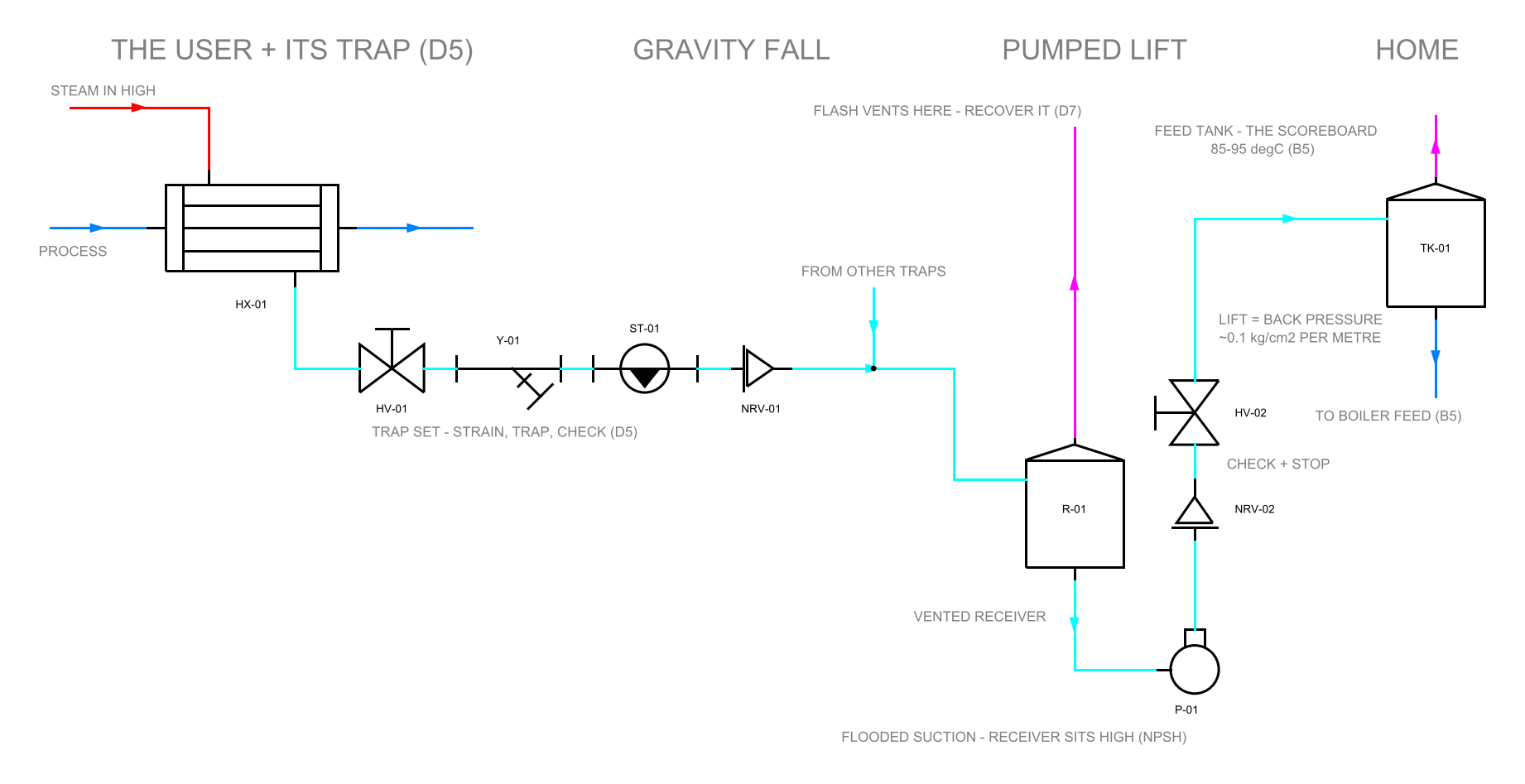
- Gravity — condensate falls to a vented receiver and on to the feed tank. Cheapest and most reliable; demands only that the layout slopes the right way. Design the collecting lines generously and the vent tall.
- Pumped — a receiver and pump lift condensate to a distant or high feed tank. Electric centrifugal pumps are standard but hate hot water: at 90 °C-plus a centrifugal pump sits on the edge of cavitation unless it has generous suction head — the classic rattling condensate pump. The alternative is a pressure-powered pump: a vessel that fills by gravity and is then pushed empty by steam itself. No motor, no seal, no cavitation, happy with boiling water — at the price of a little steam per stroke.
- Pressurised loop — keep the whole return at pressure into a deaerator or flash-recovery system; no vent, no flash loss. The premium scheme, and the natural partner of the recompression deep-dive.
The two-phase trap most schemes fall into
A condensate line is not a water line. Lesson A8 showed that condensate crossing its trap flashes ~7–16% by mass — which is ~99% by volume. A return line sized as if for water runs full of high-velocity steam pushing slugs of water: hammering, back pressure, and traps upstream that mysteriously "stopped working". Two rules:
- Size return lines for the flash vapour, not the water — in practice one to two sizes larger than the water-only calculation, falling with distance as the flash condenses;
- Count every metre of lift: ~0.1 kg/cm² of back pressure per metre, straight off every trap's working differential (the trap lesson's sizing rule).
- Measure your return fraction this week: steam raised vs make-up consumed is the honest ratio, and the feed tank thermometer is the daily proxy.
- Walk the drains: every steaming grate is a numbered finding with a ₹/year value from the arithmetic above.
- Insulate return lines — bare condensate pipe gives away the very heat you recovered.
- Check what your condensate touches: any duty where product could contaminate it (oil coolers, direct-contact processes) needs monitoring or sacrifice — contaminated condensate must NOT reach the boiler.
- A rattling condensate pump is cavitation talking: raise the receiver, cool the duty, or switch to a pressure-powered pump.
- Condensate = hot + distilled + treated: ≈ ₹150/tonne at practice-plant rates, before the blowdown bonus.
- Return fraction is the single most valuable percentage in the steam system. Measure it.
- Gravity where you can, pressure-powered pumps where it is hot, pressurised loops where it pays.
- Return lines carry flash: size for vapour, count the lift.
- Feed tank temperature is the scoreboard.
Distilled water is sold in the bazaar at many times the price of petrol-pump air and drinking water — for batteries, for laboratories, for inverters. Every steam plant manufactures tonnes of it a day as a by-product, pre-heated, and the ones without recovery pour it into a drain. Seen from the bazaar, a 60% return plant is a distillery giving away 40% of its production.
FAQ
How do I find out my plant's condensate return fraction?
Compare steam raised against make-up water consumed — that ratio is the honest answer, and most plants can build it from meters they already have. Day to day, on a tank without a steam sparge, the feed tank thermometer is the proxy: a tank sitting at 55 °C is telling you most of the condensate never comes home; at 85 °C, the loop is closing. (If a flash sparge holds your tank at 90 °C, as on the practice plant, watch the make-up meter instead — the thermometer is regulated, not honest.) Measure it this week — it is the single most valuable percentage in the steam system.
What is a tonne of returned condensate actually worth?
About ₹150 at practice-plant rates, in three parts: ~₹60 of heat (90 °C water the boiler need not reheat), ₹30–80 of avoided make-up water, and ₹20–50 of avoided treatment — condensate is distilled, so it skips the softener entirely. There is a fourth, quieter value: high return means low dissolved solids, which means less blowdown (B6 prices that bonus).
Why does my condensate pump rattle and eat seals?
That is cavitation. At 90 °C-plus, water sits close to boiling, and a centrifugal pump without generous suction head boils it in its own eye. Three exits: raise the receiver to buy suction head, cool the duty, or switch to a pressure-powered pump — a vessel pushed empty by steam itself, with no motor, no seal, and no objection to boiling water.
Can every stream of condensate go back to the boiler?
No — condensate is only valuable while it is clean. Any duty where product or oil could leak into it (oil coolers, direct-contact processes) needs monitoring or a deliberate sacrifice to drain, because contaminated condensate reaching the boiler is a chemistry incident, not a saving. Everything else belongs home.
Why does my condensate return line hammer and build back pressure?
Because it was sized as a water line, and a condensate line is not one. Condensate flashes ~7–16% by mass crossing the trap — which is ~99% by volume — so an undersized return runs full of high-velocity steam pushing slugs of water. Size for the flash vapour (one to two sizes up on the water sum), and count ~0.1 kg/cm² of back pressure for every metre of lift.
Check yourself
Five quick questions on this lesson. No marks, no records — the score is for you.