
Lessons A8 and D7 established the resource and built the basic harvest. But the flash vessel's honest precondition — a low-pressure consumer, alive and matched — is exactly what many plants lack. This lesson is the scheme-selection layer above D7: three ways to architect flash and condensate recovery — cascade, recompression, recirculation — and the logic that picks between them. It is the systems lesson behind the F4 deep-dive.
Scheme one: cascade — use it where it is
The D7 pattern generalised: let down each condensate stream into flash steam at the highest pressure some consumer can drink, and pipe it there. Multi-pressure plants cascade in chains — HP condensate flashes to feed an MP duty, MP condensate flashes to LP, LP feeds the feed tank (the paper-machine architecture from D7's story). Cascade is the cheapest scheme per kilogram recovered (vessels and pipe, no motive steam, no machinery) and the first one to test on any site. Its limit is structural: it can only move heat down the pressure ladder, so it dies exactly where plants hurt — when the flash is made at low pressure and every consumer wants more.
Scheme two: recompression — push it back up
The thermocompressor (lesson F4's whole subject) is a steam-jet pump: a nozzle of high-pressure motive steam entrains the low-pressure flash and discharges the mixture at a useful intermediate pressure. Suddenly the pressure ladder runs both ways: 0.5 kg/cm²g flash that had no home becomes 3.5 kg/cm²g process steam. The economics ride on the entrainment ratio — kilograms of LP steam lifted per kilogram of motive spent — which falls as the lift grows: modest lifts recycle handsomely; heroic lifts approach simply making fresh steam. The working questions: is there HP motive available (the practice plant's 10.5 kg/cm²g main qualifies)? Is the lift modest (suction to discharge)? Is the LP source reasonably steady (jets are happiest near their design point; F4 covers what nozzle design does to turndown)? Three yeses and recompression typically beats both venting and cascade — it is the scheme that turned the practice plant's dryer flash from ₹18–19 lakh a year vented into the same value recovered at the 3.5 header (F4's case).
Scheme three: recirculation — the closed loop over one user
Some equipment — dryer cylinders and similar surfaces — must be fed excess steam ("blow-through") to sweep condensate and air out of the surface, or it waterlogs (lesson D1's physics at machine scale). Recirculation closes that loop: the thermocompressor takes the blow-through steam from the user's separator and lifts it the small step back to the user's own inlet, motive steam making up the difference. Because the lift is tiny, the entrainment ratio is generous, and the user effectively consumes only the heat it actually transferred. This is the scheme for a single large consumer with mandatory blow-through — one machine, one loop, one jet — where cascade has nothing to offer (the steam is needed at the same pressure, not lower).
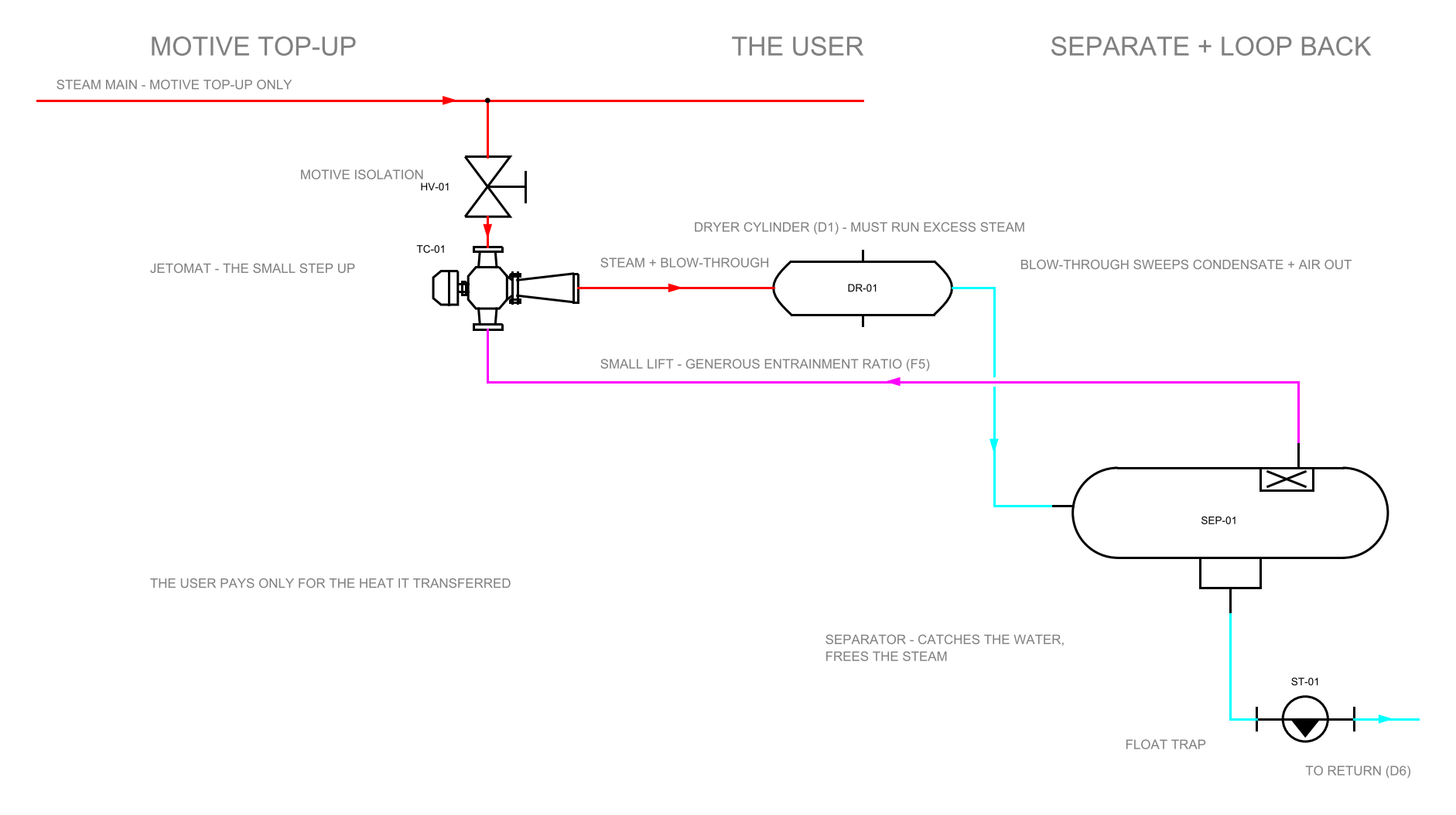
Choosing — and the electric footnote
Run the D7 audit first (source kilograms, pressures, schedules). Then: an honest LP consumer exists → cascade, and stop — machinery you don't buy never breaks. Demand sits above the flash pressure, HP motive available, modest lift → recompression; size from the entrainment-ratio curves and let F4 referee nozzle types. One big blow-through user → recirculation. Mixed sites often stack schemes: cascade what can fall, recompress the remainder. And the electric footnote for the decade ahead: mechanical vapour recompression (MVR) — a compressor doing the thermocompressor's job on electricity — buys higher ratios at the price of rotating machinery and kW; as lesson F6's economics shift, it moves from evaporator specialty toward general contention, and the scheme map above gains a fourth square.
- Map every flash source and every steam consumer on one pressure ladder — the scheme usually picks itself from that single drawing.
- Quote both cases for any recompression proposal: recovered kg/h and motive kg/h spent. The net, not the gross, is the saving (F4's honesty rule).
- Blow-through users running open-ended (steam swept to a vent or condenser) are recirculation candidates hiding as "that's how the machine came".
- Jets love steady state: check the source's swing against the design point before buying, and revisit F4's turndown discussion if it swings hard.
- Cascade moves heat down the ladder — cheapest, consumer-dependent.
- Recompression lifts it back up with HP motive — the entrainment ratio is the economics.
- Recirculation closes the loop over one blow-through user — tiny lift, generous ratio.
- Audit first (D7), stack schemes where sensible, and count the motive steam honestly.
The steam-jet ejector is one of thermodynamics' great survivors: patented forms existed by the 1900s for locomotive feedwater and ship condensers, and the device has outlived nearly every machine it once served because it has no moving parts to retire. Its twenty-first-century second act — recompressing flash steam that plants once vented — asks nothing new of the physics; only the price of the steam changed. Few industrial devices have waited a hundred years for their economics to arrive, working the whole time.
FAQ
What can I do with flash steam if no low-pressure consumer exists?
Cascade dies without a consumer below the flash pressure, so the ladder must run the other way: recompression lifts the flash back up with high-pressure motive steam (F4), turning 0.5 kg/cm²g flash nobody wants into 3.5 kg/cm²g process steam everybody wants. The other exit is a recirculation loop, where one blow-through user re-drinks its own steam.
Which recovery scheme is cheapest?
Cascade — vessels and pipe, no motive steam, no machinery — which is why it is always tested first: machinery you don't buy never breaks. Its structural limit is that heat only moves down the pressure ladder, so it needs an honest consumer alive at each level, matched in schedule as well as pressure.
When does recompression stop making sense?
When the lift gets heroic. The entrainment ratio — kilograms of flash lifted per kilogram of motive — falls as the lift grows, so a modest lift recycles handsomely while a huge one approaches simply making fresh steam. The working checklist: HP motive available, modest suction-to-discharge lift, reasonably steady source. Three yeses and it typically beats both venting and cascade.
What is recirculation, and how is it different from recompression?
Recompression feeds recovered steam to other consumers; recirculation closes the loop over one user that must run excess blow-through steam (a dryer cylinder, typically). The jet lifts the blow-through the small step back to the user's own inlet, so the lift is tiny, the entrainment ratio generous, and the machine effectively pays only for the heat it actually transferred.
Can the schemes be combined on one plant?
Mixed sites often should: cascade whatever has a consumer below it, recompress the remainder, and loop any big blow-through machine. Draw every flash source and every consumer on one pressure ladder first (D7's audit) — the combination usually picks itself from that single drawing.
Check yourself
Five quick questions on this lesson. No marks, no records — the score is for you.