
Every steam main is also, quietly, a water main. Radiation loss condenses steam against the pipe wall all day (lesson C7 prices it), and at every cold start the entire pipe run condenses steam wholesale until the metal is hot. That water must be collected and removed continuously, exactly where it forms — or it collects itself, and lesson C5 describes the explosion that follows. Draining mains is unglamorous, cheap, and the single highest return-per-rupee discipline in steam distribution.
Where the water goes
Condensate runs along the pipe bottom, pushed by the steam above it. Three rules place the collection points: Fall with the flow. Lay mains with a gentle slope in the direction of steam flow — the working convention is around 1:100 (roughly 250 mm per 25 m) — so gravity and the steam push the same way. Pocket every 30–50 metres, and at every low point, every riser bottom, and directly before every control valve and PRS (lesson C3's separator is the last line, not the first). End of line drains everything. The main's dead end is where the last of the water and the first of the air arrive — a drain pocket and an air vent (lesson C8) live there together.
The pocket that actually catches water
Here is the detail that separates working drainage from decoration: a small tapping on the bottom of a big pipe catches almost nothing. Condensate sweeping along at steam velocity simply jumps a 15 mm hole. The proper drain pocket is a stub of pipe — large pipe — tee'd downward off the main: the same diameter as the main up to DN100, and one or two sizes down (but never less than DN100) on larger mains, deep enough to give the water somewhere to fall out of the flow. The trap connection comes off the pocket's side, above the dirt that collects in its bottom, and a blowdown plug on the pocket floor lets that dirt leave at maintenance.
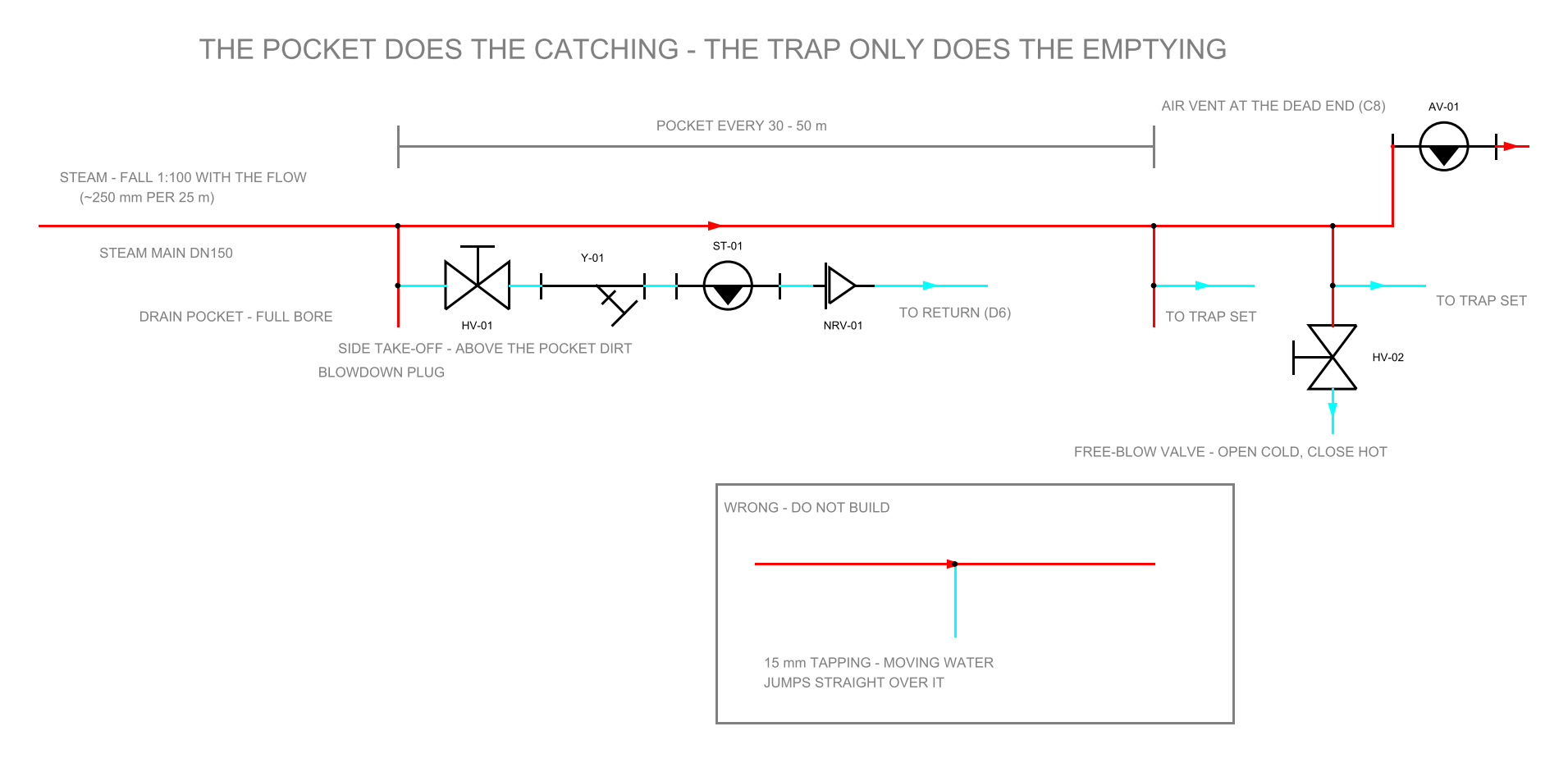
Start-up: the flood hour
A cold DN150 main being warmed swallows steam and sheds condensate at many times its running rate — this is lesson A10's warm-up load applied to the pipe itself. Two disciplines manage the flood. Warm slowly: crack the isolation valve and let the main come up over twenty to thirty minutes; a main slammed open is the classic water-hammer overture (lesson C5). Let the traps breathe: the drain trap chosen for each pocket must pass the start-up flood at almost no pressure differential — the thermodynamic trap that shines at running pressure is feeble at start-up, which is why mains drainage is float-and-thermostatic or inverted-bucket territory (the full selection matrix is lesson D5). Plants that start daily often fit a manual free-blow valve at the far end: open it cold, close it hot, and the flood leaves by the shortest route.
What good drainage buys
Dry steam at the users (lesson A9's payload arithmetic), erosion-free valve seats, mains that warm without banging, and — the quiet one — honest instrument readings, since slugs of water past an orifice or vortex meter (lesson D8) wreck both the reading and, eventually, the meter. The whole discipline costs a handful of pockets, traps and vents per hundred metres; the alternative is priced in lesson C5's accident reports.
- Walk the main with the layout drawing: mark every low point, riser bottom and dead end. Each one either has a pocket or has a future problem.
- Check pocket construction, not just presence — full-bore stub, side trap take-off, bottom blowdown. A 15 mm nipple into a DN150 main is decoration.
- Listen at start-up: banging = water meeting steam = drainage failing exactly where the noise is. Free, precise diagnostics.
- Slope: water lying against a backslope shows itself as a wet, hammering section after every shutdown. Re-supporting a sagged span is cheaper than the valve it will eventually destroy.
- Mains make water all day; drainage removes it where it forms — every 30–50 m, every low point, before every valve, at every dead end.
- The pocket does the catching, the trap only the emptying. Full-bore pockets, side take-offs.
- Slope with the flow, ~1:100.
- Start-up is the design case: warm slowly, and pick traps that pass the flood at zero differential.
Railway steam heating taught this lesson at scale: carriage-heating mains running the length of a train, coupled and uncoupled daily, drained (or not) at every low point of every siding. The fitters' rule of thumb — "water always finds the low joint" — was earned one frozen, split fitting at a time across a century of winters. Your plant's main obeys the same rule; it just has fewer excuses, because it never moves.
FAQ
How far apart should drain points be on a steam main?
Every 30–50 metres of run — plus, non-negotiably, at every low point, at the bottom of every riser, directly before every control valve or reducing station, and at the dead end of the line. The spacing rule covers the water made along the way; the fixed points cover the places it collects.
My drain trap never seems to pass anything. Is the trap dead?
Check the pocket before the trap. A 15 mm tapping on the bottom of a big main catches almost nothing — condensate sweeping along at steam velocity jumps straight over it. A working pocket is a full-bore stub tee'd downward (same size as the main up to DN100), with the trap taken off its side and a blowdown plug in its floor. The pocket does the catching; the trap only does the emptying.
Which trap type is right for mains drainage?
One that can pass the start-up flood at almost no pressure differential — which puts mains drainage in float-and-thermostatic or inverted-bucket territory. The thermodynamic trap that performs beautifully at running pressure is feeble exactly when the main needs it most: cold, flooded, and at zero differential. The full selection matrix is in D5.
How slowly should a cold main be brought up?
Crack the isolation valve and give a cold main twenty to thirty minutes — a warming pipe sheds condensate at many times its running rate, and a main slammed open is the classic overture to water hammer (C5). Plants that start daily often fit a manual free-blow valve at the far end: open cold, close hot.
Which way should a steam main slope?
With the steam flow, at about 1:100 — roughly 250 mm per 25 m — so gravity and the steam push the water the same way. A sagged span or backslope shows itself after every shutdown as a wet, hammering section; re-supporting the span is far cheaper than the valve the standing water will eventually destroy.
Check yourself
Five quick questions on this lesson. No marks, no records — the score is for you.