
The standing rule of steam economics — generate and distribute high, reduce and use low (lesson A6) — has a piece of hardware where it comes true: the pressure-reducing station. The practice plant's dryer runs at 7 kg/cm²g and its vessel at 3.5, both fed from 10.5 kg/cm²g mains, and a PRS stands guard at each branch. This lesson is the anatomy of a station that holds its pressure for years — and the shortcuts that guarantee one that hunts, leaks and fails young.
Why reduce at all
Distribution loves high pressure: vg at 10.5 kg/cm²g is 0.173 m³/kg against 0.419 at 3.5, so the same pipe carries two and a half times the mass flow (lesson C2's arithmetic). Processes love low pressure: more latent heat per kilogram, gentler surface temperatures, and less flash loss from the condensate afterwards (lesson A8). So the plant runs its arteries high and steps down at each consumer — which puts a control valve, not the boiler, in charge of every process pressure. Get the station right and every downstream lesson gets easier.
The anatomy, upstream to downstream
A PRS is never just the reducing valve. The working sequence: isolation valve — maintenance begins here · separator + trap — the reducing valve's seat is machined to a polish, and wet steam at 25 m/s is liquid sandpaper; dry the steam before it arrives (lesson A9) · strainer, fitted on its side — catches the mill scale and weld spatter; sideways, so its basket doesn't become a condensate pocket · the pressure-reducing valve — pilot-operated for tight control at varying load, direct-acting for small steady duties · a generous expansion of pipe size — lower pressure means fatter steam (that vg again); the downstream line is always larger · safety valve — sized for the full failed-open capacity of the PRV, because the downstream equipment was bought for 3.5, not 10.5 (lesson D10) · gauges either side, and a downstream sensing point far enough from the valve to read settled pressure, not turbulence.
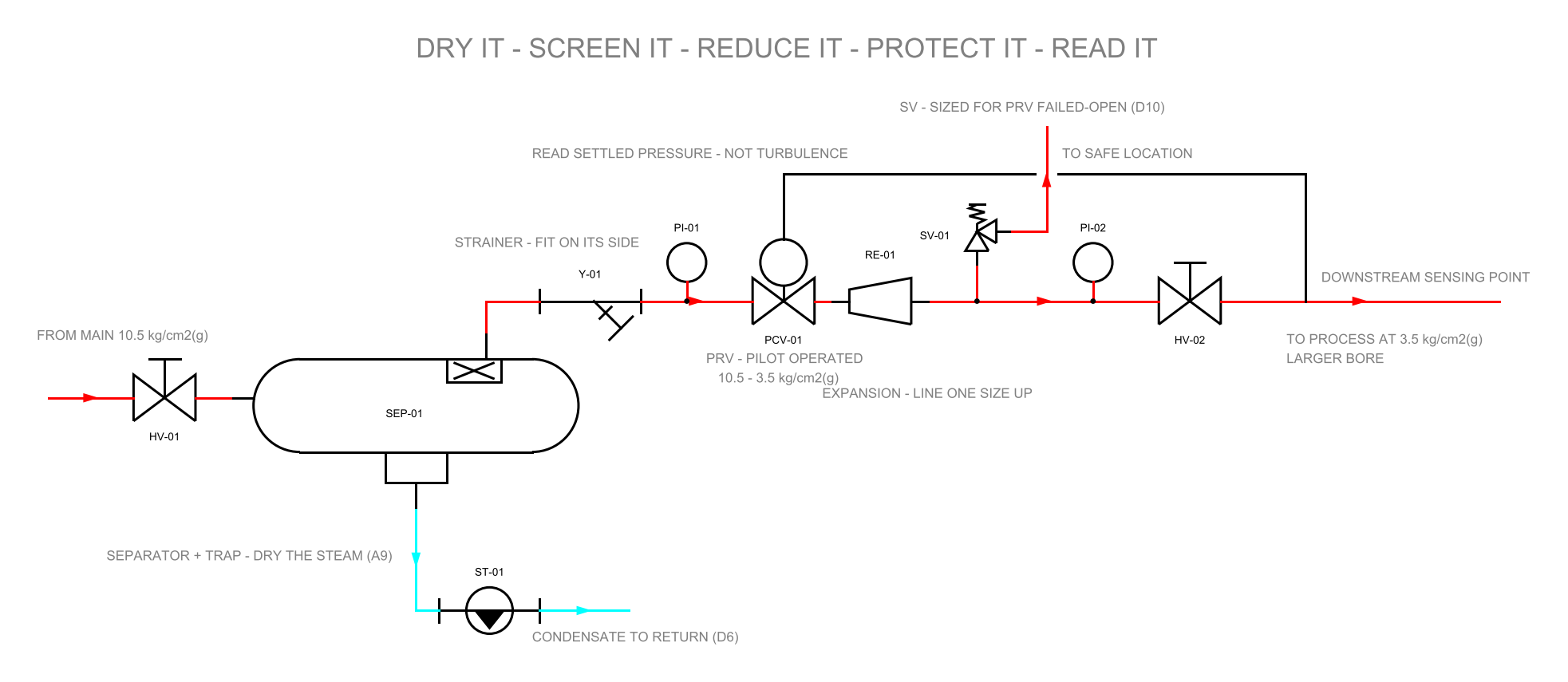
Sizing: the part everyone gets backwards
A reducing valve is sized by its capacity at the pressure drop (Kv — lesson D3 does the full method), never by the pipe it sits in. Size it to the line and it is almost always oversized — and an oversized PRV controls on the first few percent of its travel, hunting between overshoot and slam, wearing its seat in months. The practice plant's dryer branch wants 3,500 kg/h across 10.5→7: that duty, plus honest margin (lesson A10's rule — stated, not compounded), picks the valve. Expect the correct PRV to look "too small" next to its pipework; that is what right looks like. For big turndowns — a duty swinging from 300 to 3,500 kg/h — use two stations in parallel (one small, one large, split-range) rather than one valve asked to control a 10:1 range it cannot.
Two honest warnings
Deep cuts make superheat. Reduction is isenthalpic: the practice plant's 10.5→3.5 station delivers ~17 °C of superheat at the valve outlet (lesson A7's arithmetic). For most duties it fades in the pipework; for a close-coupled, temperature-sensitive process, budget a desuperheater (lesson D4). Noise is design data. A PRS taking a big cut at high velocity is loud — and chronic screaming means velocities that erode internals. Generous downstream pipe sizing, noise-treated trim on the bigger cuts, or a two-stage reduction are the fixes; earplugs are not.
- Walk each PRS against the anatomy list: separator trapped? strainer sideways and when was it last cleaned? safety valve actually sized for PRV failure, or just "one that fit"?
- Hunting pressure gauge = oversized or worn PRV, or a sensing line tapped in turbulence. Check size against duty before condemning the valve.
- Downstream pipe should be at least one size up. Same-size both sides is the signature of a station built by pipe-fitters without the datasheet.
- Log set pressures and seat condition at annual overhaul — PRV wear trends tell you about your steam quality (lesson A9) before anything else does.
- Distribute high (thin steam, small pipes), use low (fat latent heat) — the PRS is where the rule becomes hardware.
- A station is a system: dry → screen → reduce → protect → read. The valve alone is half a station.
- Size the PRV by Kv at the duty, never by pipe size. Right looks small.
- The downstream safety valve answers for the PRV's failed-open day — size it for that, always.
- Deep reductions arrive superheated; big turndowns want parallel stations.
The self-acting pressure regulator is older than the electric light: nineteenth-century gasworks and steam plants used weighted and spring-loaded reducing valves whose descendants still guard LPG cylinders in every Indian kitchen. The pilot-operated steam PRV added one idea — use the steam's own pressure, sensed downstream, to position the main valve — a pneumatic feedback loop with no electronics, holding set-point through load swings a hand-regulated bypass could never follow. Control theory arrived in brass, decades before it arrived on paper.
FAQ
Can I install just the reducing valve, without the separator and strainer?
You can, and the valve will pay for the shortcut. A PRV's seat is machined to a polish, and wet steam at line velocity is liquid sandpaper; the separator dries the steam and the sideways strainer catches mill scale before either reaches the seat. Everything before the valve exists to protect the valve — leave it out and the station fails young.
Why does my downstream pressure gauge keep hunting?
Three usual suspects, in order: a PRV oversized for the duty, controlling on the first few percent of travel and cycling between overshoot and slam; a worn seat from wet or dirty steam; or a sensing line tapped too close to the valve, reading turbulence instead of settled pressure. Check the valve's size against the actual duty before condemning it.
Do I really need a safety valve after every reducing station?
Yes — and sized for the PRV's full failed-open capacity, not just "one that fit". The downstream equipment was bought and rated for the reduced pressure; the day the PRV jams open, that safety valve is the only thing standing between 10.5 kg/cm²g and vessels rated for 3.5. D10 covers the sizing.
Why is the steam hotter than saturation just after my PRV?
Because reduction is isenthalpic: the energy per kilogram survives the cut, so a deep reduction like 10.5→3.5 kg/cm²g arrives with about 17 °C of superheat at the valve outlet. For most duties it fades in the pipework; if a close-coupled process is temperature-sensitive, budget a desuperheater (D4).
My load swings from 300 to 3,500 kg/h. One big valve or two stations?
Two, in parallel — one small, one large, split-range. A single valve asked to control a 10:1 turndown spends its life either nearly shut or hunting; the small valve carries the quiet hours and the large one steps in for peak. One valve doing everything is the cheaper purchase and the dearer ownership.
Check yourself
Five quick questions on this lesson. No marks, no records — the score is for you.