
The steam trap is the cheapest automatic valve on your plant and the most consequential per rupee: a few thousand rupees of hardware standing between every heating surface and two opposite disasters — flooding the equipment with condensate, or blowing live steam into the drain. A trap's whole job is one act of discrimination, performed automatically, thousands of times a day, for years: pass condensate and air; hold steam. This lesson is the complete working school: how each family tells the difference, which one belongs where, how to size, install and test them.
Three ways to tell steam from water
Every trap ever made discriminates by one of three physical differences:
By density — the mechanical family
Ball float: condensate lifts a float; the float opens a valve under the water line, so discharge is continuous and immediate, at steam temperature, with no banked-up condensate. A built-in thermostatic air vent handles start-up air. This is the default trap for process heat exchange — jacketed vessels, heat exchangers, dryers — anything whose output suffers when condensate backs up. Its weaknesses: water hammer can crush floats, and it must be mounted level.
Inverted bucket: steam entering the trap floats an upside-down bucket and shuts the valve; when steam inside condenses or escapes through the bucket's vent hole, the bucket sinks and the valve opens. Rugged, water-hammer tolerant, works at high pressure — but discharges in bursts, vents air slowly, and can lose its water seal ("prime") on superheat or sudden pressure loss, then blow steam continuously.
By temperature — the thermostatic family
Balanced pressure: a capsule of volatile fill boils and shuts the valve just below saturation temperature — at any pressure, self-adjusting. It deliberately holds condensate back until it cools a few degrees: superb for air venting and steam tracing (where the pipe can hold cooling condensate harmlessly), wrong for process equipment (where held-back condensate floods the surface).
Bimetallic: stacked bimetal leaves pull the valve shut against saturation temperature; adjustable subcooling, robust against water hammer and superheat, common on high-pressure mains and tracing. Same caveat: it banks condensate by design.
By velocity — the thermodynamic disc
Hot condensate flashing under a flat disc creates high-velocity vapour that snaps the disc shut; the trap literally uses lesson A8's flash steam as its brain. Compact, cheap, any mounting position, shrugs off water hammer and superheat — the standard drip trap for steam-main drainage. Weaknesses: needs a minimum differential to work, dislikes high back pressure (makers rate it to about 80% of inlet pressure; beyond that it stutters), and every audible click is a little steam spent — a rapid-cycling disc trap is wearing itself out loudly. The panel below puts the four principal working elements side by side.
The selection matrix
| Application | First choice | Also works | Avoid — and why |
|---|---|---|---|
| Heat exchangers, jacketed vessels, dryers (process duty) | Ball float | Inverted bucket | Thermostatic — banks condensate, starves the surface; TD — back-pressure sensitive |
| Steam-main drip points | Thermodynamic disc | Inverted bucket, bimetallic | Float on hammer-prone mains (crushable) |
| Steam tracing | Balanced pressure / bimetallic | TD disc | Float — overkill; you WANT the subcooling here |
| Air vents on vessels & main ends | Balanced pressure (as air vent) | — | TD — poor air handling can air-bind it |
| High pressure / superheat service | Bimetallic | Inverted bucket | Balanced-pressure capsules beyond their rating |
Sizing: capacity, not connection
"A DN25 trap" names a pipe connection, not a capacity — the same DN25 body is sold with several orifice sizes, and depending on the orifice a DN25 can out-pass or under-pass a DN15. Buy capacity, not pipe size. Size on three numbers:
- Condensate load (kg/h) from the equipment duty;
- × a start-up factor of 2–3, because cold equipment condenses fastest in its first minutes;
- at the actual differential pressure: inlet pressure minus back pressure. A trap discharging into a rooftop return line loses about 0.1 kg/cm² per metre of lift — a trap that "works on test" and floods in service was usually sized ignoring this line.
Three sharpeners on those numbers. Why the factor exists: catalogue capacity charts are made with cold water flowing continuously — but near-boiling condensate flashes as it crosses the orifice, and the vapour chokes the passage, cutting real hot capacity to a fraction of the chart (the same physics that lets cold start-up condensate race through several times faster than hot). The safety factor is not superstition; it is the chart's fine print. Where the inlet pressure really comes from: a trap after a modulating control valve sees the valve's outlet pressure at the running load — not the header. Size on that, and remember it falls as the valve throttles until, at low load, the differential can vanish entirely: that is stall (lesson G3), and no orifice cures it. And one safety line: the trap's body and orifice must be rated for the highest pressure the line can ever see — the safety valve's set pressure, not the comfortable operating number.
The trap station, and the group-trapping sin
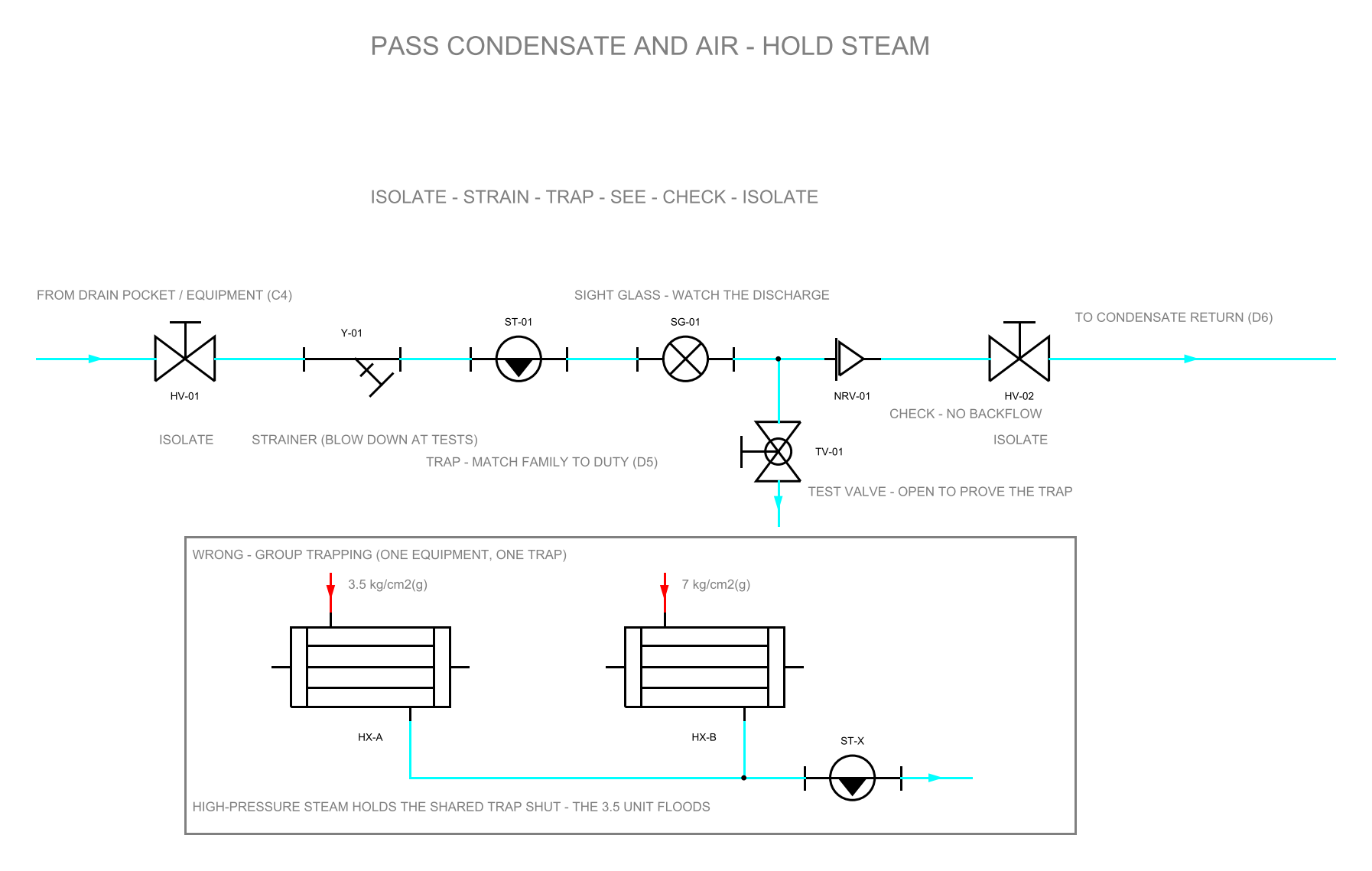
Two disciplines around the station:
- One equipment, one trap. Group-trapping — several exchangers into one trap — always starves the unit with the lowest pressure: steam from the higher-pressure neighbour short-circuits through the shared trap and holds it shut. The saved trap costs a flooded exchanger every day thereafter.
- Think twice about bypasses. A bypass valve is a leak with paperwork: surveys keep finding them cracked open "since last cleaning". Prefer isolation plus a spare trap station on critical duties.
Testing: the two failure directions
Failed open — the trap blows live steam. Invisible if the discharge is piped away; listen (ultrasound through the body), watch the sight glass (a sharp transparent jet at the orifice = steam; cloudy tumbling flow = flashing condensate — A8 taught you the difference), or read temperatures. Cost: a permanent 2–4 mm leak, ₹1–2 lakh/year at typical pressures (the leak lesson's arithmetic).
Failed shut / flooded — the trap is cold, the equipment is slow, and production blames the boiler. A trap at ambient temperature on a live line is always a finding.
- Number every trap and keep a register: location, type, size, duty, last test, result. The register turns trap maintenance from folklore into a system.
- Survey yearly minimum; six-monthly where steam is costly. Test at operating pressure, never on a cold plant.
- Match the family to the duty using the matrix — the commonest selection error is a TD disc doing a float's process job because it was cheaper that day.
- Fit strainers before every trap, and blow them down when you test.
- When a trap fails twice in a year, stop replacing and start asking: water hammer? dirt? wrong type? undersized? The trap is the witness, not the culprit.
- One job: pass condensate and air, hold steam. Three discriminators: density, temperature, velocity.
- Process duty → float. Main drips → TD/bucket. Tracing and air → thermostatic.
- Size on load × 2–3 start-up factor at the REAL differential — lift steals it.
- One equipment, one trap. Group trapping starves the weakest.
- Two failure directions: open burns money, shut burns production. Survey for both.
The earliest steam traps were literal: cast vessels that filled with condensate until a float or a tipping bucket physically dumped the catch, like a mousetrap for water. The name stuck through every refinement since. A modern float trap is still the same idea a Victorian millwright would recognise — a bucket that empties itself — just machined to tolerances that let it do so forty thousand times between inspections.
FAQ
Which steam trap is simply the best?
None — that question is how the wrong trap gets bought. Each family discriminates steam from water differently, and the duty decides: ball float for process heat exchange (continuous discharge, no banked condensate), thermodynamic disc for steam-main drip points, thermostatic for tracing and air venting, where its deliberate subcooling is a feature. The commonest error is a cheap disc trap doing a float's process job.
Can two or three exchangers share one trap?
No — this is the group-trapping sin. Steam from the higher-pressure neighbour short-circuits through the shared trap and holds it shut, so the unit with the lowest pressure floods, every day, forever. The trap you saved costs you a starved exchanger. One equipment, one trap — no exceptions worth having.
My trap passed on the bench but its equipment floods in service. Why?
Almost always the differential was fictional. Sizing must use inlet pressure minus real back pressure, and a discharge lifted to a rooftop return loses about 0.1 kg/cm² for every metre of rise. Add the start-up factor of 2–3 on load, and a trap that "worked on test" is suddenly half the size the service needed.
How do I tell live steam from flash steam at a trap discharge?
Look at the jet: a sharp, almost transparent cone right at the orifice is live steam — a failure. A soft, cloudy, tumbling plume that appears a little downstream is flash steam from hot condensate, which is normal (A8 taught the physics). Ultrasound through the body settles arguments the eye cannot.
A trap on a live line is stone cold. Is that fine?
A cold trap on a live steam line is always a finding — it means the trap has failed shut or the line is flooded, and somewhere upstream a heating surface is drowning while production blames the boiler. Failed-shut traps burn output rather than money, which is why they hide longer than steam-blowing ones.
Check yourself
Five quick questions on this lesson. No marks, no records — the score is for you.