
A dairy in Karnal, a paper mill in Vapi, a refinery in Jamnagar: strip away the scale and the product, and their steam systems are the same country with the same four provinces. Learn this map once and you can navigate any steam plant you ever walk into — and every lesson in this academy has an address on it.
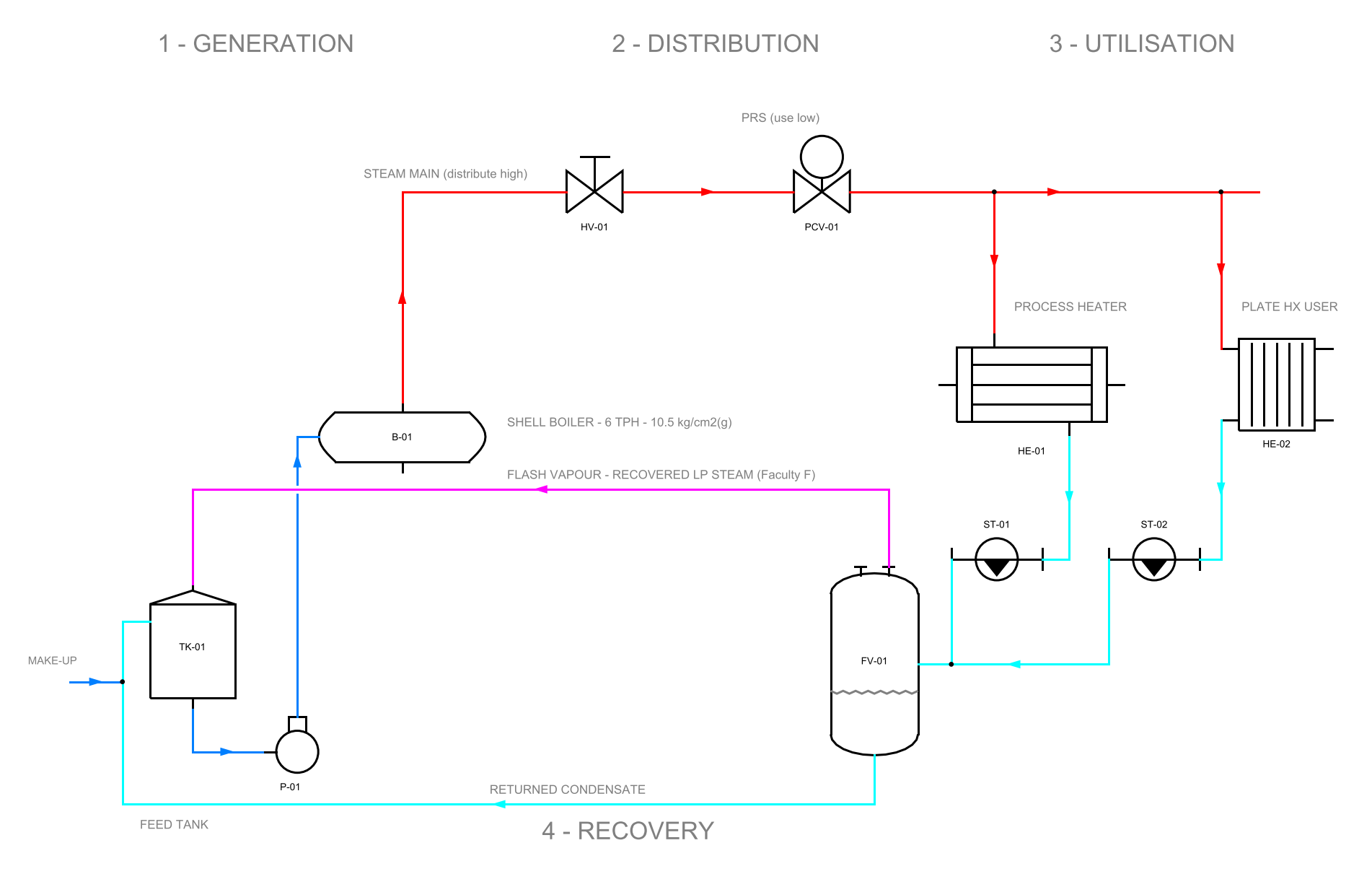
Province 1 — Generation
Feed tank, feed pump, boiler. Water arrives (returned condensate plus treated make-up), gets pumped to boiler pressure, and leaves as steam — at the practice plant, 6,000 kg/h at 10.5 kg/cm²g. Generation is where the fuel bill lives, so it is where efficiency points are worth the most: boiler losses, feedwater temperature, blowdown. The Boiler House faculty governs here. Classic failure of the province: nobody measures, so a 75% boiler is remembered as an 85% one.
Province 2 — Distribution
The header, the mains, the branches, and the pressure-reducing stations that step high-pressure transport steam down to each user's working pressure. Distribution's whole job is to deliver steam dry, at the right pressure, with little loss — which decomposes into pipe sizing, insulation, main drainage and leak discipline, each with its own lesson in the Steam Distribution faculty. Classic failures: pipes sized by habit, bare valves and flanges, drain points missing, and the hiss nobody hears any more.
Province 3 — Utilisation
Where steam meets product: heat exchangers, jacketed vessels, dryers, direct injection. The steam gives up its latent heat through a surface and becomes condensate — job done. Utilisation questions are control questions: the right pressure (hence temperature), the right valve, and equipment that can actually drain itself. Using Steam & Getting It Back teaches this province. Classic failure: a starved or flooded exchanger blamed on the boiler, two provinces upstream.
Province 4 — Recovery
The province most plants forget is on the map. Traps pass the condensate out of the equipment; the return system carries it — still hot, still treated, still paid-for — back to the feed tank, harvesting flash steam on the way. Recovery closes the loop and returns roughly a quarter of the fuel investment. Its lessons: steam traps, condensate recovery, flash recovery, and the deep-dive recompression technologies. Classic failure: the drain. Just — the drain.
The law of the loop
What makes this a system rather than four departments is one conservation statement: every kilogram of steam that leaves the boiler must be accounted for somewhere on the map — returned as condensate, lost as flash at a vent, blown down, leaked, or left in the product. Write it as a balance and the plant's health becomes arithmetic:
Note where blowdown sits: it is not a destination of raised steam — it leaves the boiler as water, before evaporation — so it belongs on the feedwater side of the ledger, not among the missing 48 t. Every line of that ledger is a lesson in this academy, and every lesson ends in rupees. A plant that can fill in this table from measurements — not estimates — is already halfway through its first energy audit.
- Draw your own SCH-01: one page, four provinces, every user on the map. It is the single most useful document a steam plant can own, and most don't have one.
- Walk the loop physically, boiler to furthest user to feed tank, once a quarter. Plants drift; drawings don't notice.
- Find your feed tank thermometer. Its reading is the whole recovery province in one number: 90 °C says the loop is closed; 40 °C says the map has a hole.
- Fill in the water ledger above for your plant. The line you cannot fill is the audit finding.
- Four provinces: Generation → Distribution → Utilisation → Recovery. Every plant, every scale.
- Steam out must equal water accounted: the loop is a ledger.
- Each province has its own classic failure — and its own faculty in this academy.
- Feed tank temperature is the health meter of the whole map.
Before steam, factories were shaped by their power source: mills crowded around waterwheels, machines chained to line shafts, buildings tall and narrow to stay close to the wheel. Steam pipes dissolved that geometry — heat and power could finally travel to the process instead of the process crowding around the power. The sprawling single-storey process plant you work in today is a building drawn by its steam main.
FAQ
How do I know if my condensate return is good enough?
Measure it the way the ledger does: steam raised versus condensate arriving back at the feed tank. The practice plant gets 72 t of its 120 t home — 60% — and pays for 48 t/day of treated make-up heated from 30 °C just to replace unreturned steam (blowdown draws its own ≈11 t on top — lesson B6). The quickest single check is the feed-tank thermometer: near 90 °C means the loop is largely closed; 40 °C means the map has a hole. D6 prices the fix.
My heat exchanger is underperforming. Why not blame the boiler first?
Because faults usually live in the province where the symptom appears. A starved or flooded exchanger is almost always a Utilisation problem — wrong pressure at the valve, or equipment that cannot drain itself — two provinces downstream of the boiler. Walk the map backwards from the symptom one province at a time before condemning the generation end.
What happens to steam that never comes back as condensate?
The law of the loop says every kilogram is somewhere: flashed off at receiver vents, leaked from glands and flanges, sent to drain with unreturned condensate, or left in the product. The practice plant's missing 48 t/day splits into exactly those lines — none of it simply disappears, and each line has its own lesson and its own price. (Blowdown is the loop's water-side sibling: it leaves as boiler water that never became steam, so it is counted against feedwater, not against raised steam.)
Why is make-up water expensive when raw water is cheap?
Make-up replaces every kilogram of condensate that fails to return, and it arrives raw: it must be treated and then heated from about 30 °C — both paid from the chemicals and fuel bills. Returned condensate is already treated and already hot, which is why the recovery province returns roughly a quarter of the fuel investment.
Where do I start if I want to audit my own steam plant?
Fill in the water ledger: steam raised, condensate returned, and where the difference went — flash, leaks, drain — plus blowdown on the feedwater side. The line you cannot fill from measurements is your first audit finding. Then walk the loop physically, boiler to furthest user to feed tank; plants drift, and drawings don't notice.
Check yourself
Five quick questions on this lesson. No marks, no records — the score is for you.