
Lesson A7 ended with a problem it did not solve: deep pressure reduction manufactures superheat, and process heat transfer wants none of it. The desuperheater (DSH) is the solution — a device that injects precisely enough water into superheated steam to bring it back to the saturation line, where it condenses properly again. This lesson covers when you need one, how the main types work, and the control details that separate a crisp installation from a wet one.
When a DSH earns its place
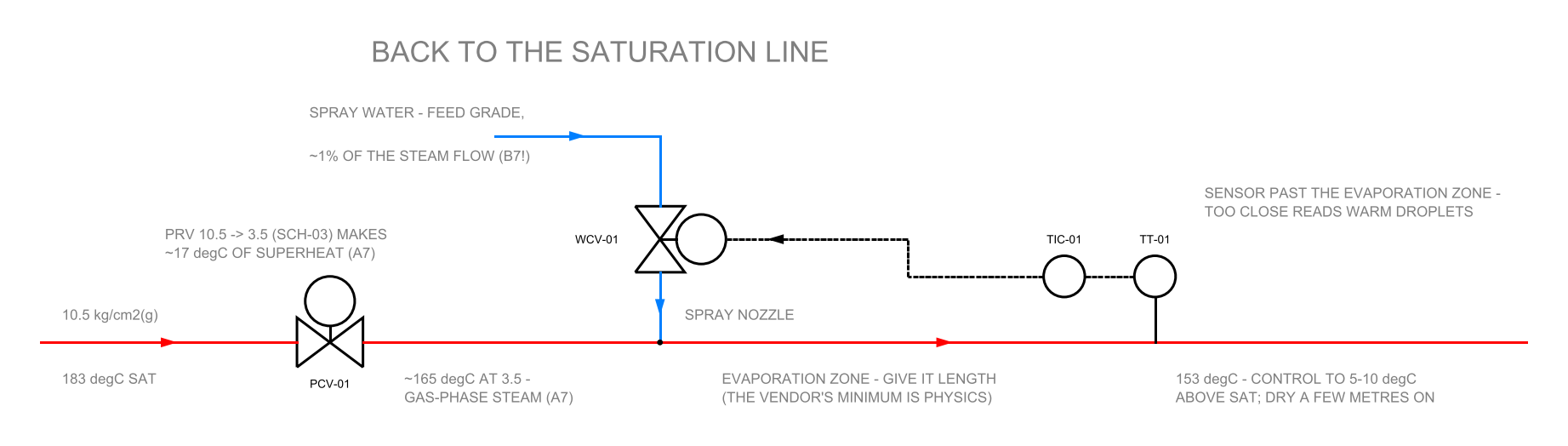
Modest superheat — a few degrees — dies naturally in the pipework; no hardware needed. The DSH cases are: close-coupled reduction, where a big pressure cut sits near a temperature-sensitive process (the practice plant's 10.5→3.5 kg/cm²g station delivers ~165 °C steam where the table promises 148 — lesson A7's arithmetic); cogeneration extraction, where turbine exhaust or pass-out steam arrives deliberately superheated and the process network needs it saturated; and any exchanger sized on condensing coefficients that is quietly receiving gas-phase steam and under-delivering (lesson A11's film-coefficient gap doing invisible damage). The combined station — pressure reduction and desuperheating in one assembly — is the PRDS, the standard front door to a low-pressure process network fed from high-pressure or turbine steam.
The water quantity: one enthalpy balance
Spray water absorbs heat warming to saturation and evaporating; every kilogram removes (hg − hwater) while the steam sheds ~0.5 kcal/kg per °C of superheat. For the practice plant's station — 1,000 kg/h at 165 °C where saturation is 148 °C, spray water from the 90 °C feed system:
heat to remove ≈ 1,000 × 0.5 × (165 − 148 − 5) ≈
6,000 kcal/h
water ≈ 6,000 ÷ (657 − 90) ≈ 11 kg/h — about 1.1% of the steam flow
(The −5 is deliberate: DSHs control to a few degrees above saturation — typically 5–10 °C — because aiming at exactly zero superheat guarantees overshoot into wet steam whenever load moves. A little residual superheat is the stable target; bone-dry saturation is the outcome a few metres downstream.)
The types, briefly and honestly
Spray (direct-contact) — a nozzle injecting water into the steam line; simple, cheap, the default. Its honest limits: turndown (a plain nozzle atomises poorly at low water flow — quality nozzles or variable-geometry designs stretch this) and a need for straight, refractory-of-purpose pipe downstream while droplets evaporate. Steam-atomising and venturi types — use auxiliary steam or a throat to shatter the water finer; better turndown and shorter evaporation lengths, at more cost and complexity. Surface (indirect) desuperheaters — a heat exchanger shedding superheat to another duty; niche, but the only choice where nothing may be added to the steam. Across all types, two disciplines dominate results: spray-water quality — boiler-feed grade, because every dissolved solid in that water is left behind in the steam path as scale when the droplet evaporates (lesson B7's chemistry arriving by air mail); and sensor placement — the temperature element must sit far enough downstream (past the evaporation zone) to read genuinely mixed, dry steam; a sensor too close reads warm droplets and the loop chases fiction.
- Suspect uninvited superheat wherever a big pressure cut feeds a close-coupled process: thermometer vs steam table (A7's test), then this lesson.
- Wet floors or hammering downstream of a DSH = overspray: sensor too close, target set at zero superheat, or a nozzle turning down badly. Check in that order.
- Trace spray-water back to its source: it must be feed-grade. Raw water through a DSH writes lesson B7's scale story inside your steam line.
- Give the evaporation zone its length — the vendor's minimum straight distances are physics, not lawyer-caution.
- DSH = controlled water injection returning superheated steam to (nearly) the saturation line.
- Water quantity ≈ 1–2% of steam flow for typical PRS-made superheat (more where turbine or extraction steam arrives deliberately hot) — one enthalpy balance sizes it.
- Control to 5–10 °C above saturation; zero is an overshoot instruction.
- Spray water is feed-grade or the steam line scales; the sensor sits past the evaporation zone or the loop lies.
- PRDS = PRV + DSH in one station — the front door of most LP process networks.
Desuperheating was born in the engine room: marine auxiliary machinery — pumps, winches, heating — was fed from boilers making superheated steam for the main turbines, and auxiliaries fed neat superheat wore out their valve gear years early. The auxiliary desuperheater became standard shipboard practice in the early twentieth century, spraying feed water into the auxiliary main. The naval logic transfers unchanged to every Indian cogen plant: make steam hot for the machine that makes power, then civilise it for everything else.
FAQ
Do I need a desuperheater after every pressure-reducing valve?
No. A few degrees of superheat dies naturally in the pipework. The DSH cases are a big pressure cut close-coupled to a temperature-sensitive process, cogen extraction steam that arrives deliberately superheated, and any exchanger sized on condensing coefficients that is quietly receiving gas-phase steam. Run A7's thermometer-versus-steam-table test first; it tells you whether you have a case.
Why do DSHs control to 5–10 °C above saturation instead of zero?
Because aiming at exactly zero superheat guarantees overshoot into wet steam every time the load moves. A few degrees of residual superheat is the stable target; the steam finishes drying to saturation on its own a few metres downstream. Setting the target at zero is an overspray instruction, and wet floors follow.
How much spray water will a desuperheater consume?
Typically 1–2% of the steam flow for PRS-made superheat — one enthalpy balance sizes it. The practice plant's station de-superheats 1,000 kg/h from 165 °C toward 148 °C saturation with about 11 kg/h of 90 °C feed water, i.e. ~1%. Each kilogram of spray absorbs its warming plus evaporation, roughly hg minus the water's own enthalpy.
Can I feed the spray nozzle from the softener instead of the feed system?
Use boiler-feed grade, nothing less. Every dissolved solid in the spray water is left behind in the steam path when the droplet evaporates — scale, delivered by air mail, exactly where you cannot easily clean. Trace the spray line back to its source once; it is a five-minute audit that prevents a shutdown-grade problem.
There is water hammer and a wet floor downstream of my DSH. Where do I look?
That is overspray. Check in this order: a sensor sitting too close (it reads warm droplets, so the loop keeps adding water), a target set at zero superheat, and a plain nozzle atomising badly at low water flow. Also confirm the evaporation zone has the vendor's minimum straight length — that distance is physics, not lawyer-caution.
Check yourself
Five quick questions on this lesson. No marks, no records — the score is for you.