
The control valve is where the plant's intentions become steam flow — and the most routinely mis-sized component in Indian steam systems, because it is so often bought by pipe size. This lesson is the working selection method: capacity by Kv, the critical-drop check, the characteristic choice, and the actuator — finished with a real selection for the practice plant's jacketed vessel.
Kv: capacity, honestly stated
A valve's Kv is its flow coefficient — the capacity of the open valve at a stated travel (Kvs fully open). For dry saturated steam the working formulas, with pressures in bar absolute and flow in kg/h, are:
Sub-critical (P₂ > 0.58 P₁): ṁ ≈ 12 · Kv ·
√(ΔP · P₂)
Critical (P₂ ≤ 0.58 P₁): ṁ ≈ 6 · Kv · P₁
The second line is the famous one. Drop the downstream pressure below about 58% of the upstream and the steam reaches sonic velocity in the valve throat — choked flow (the glossary term the thermocompressor lesson also leans on). Past that point, lowering P₂ further changes nothing: capacity depends on P₁ alone. This is why a valve venting to atmosphere from 10.5 kg/cm²g cannot be "helped" by a bigger downstream pipe, and why deep-cut PRVs roar (lesson C3) — the throat is running at the speed of sound.
The worked selection
The practice plant's jacketed vessel (lesson A10): peak duty 760 kg/h. Supply after the PRS: 3.5 kg/cm²g = 4.45 bar a. Full-load jacket pressure: 3.0 kg/cm²g = 3.96 bar a (143 °C — still 53 °C of driving ΔT over the 90 °C product end-point; the half-kilo the valve drops when wide is the same drop lesson A11 assumed).
1. Critical check: 0.58 × 4.45 = 2.58 bar a. P₂ = 3.96 > 2.58 —
comfortably sub-critical; use the first formula.
2. Kv required: Kv = 760 ÷ (12 × √(0.49 × 3.96)) = 760 ÷ 16.7 ≈
45.
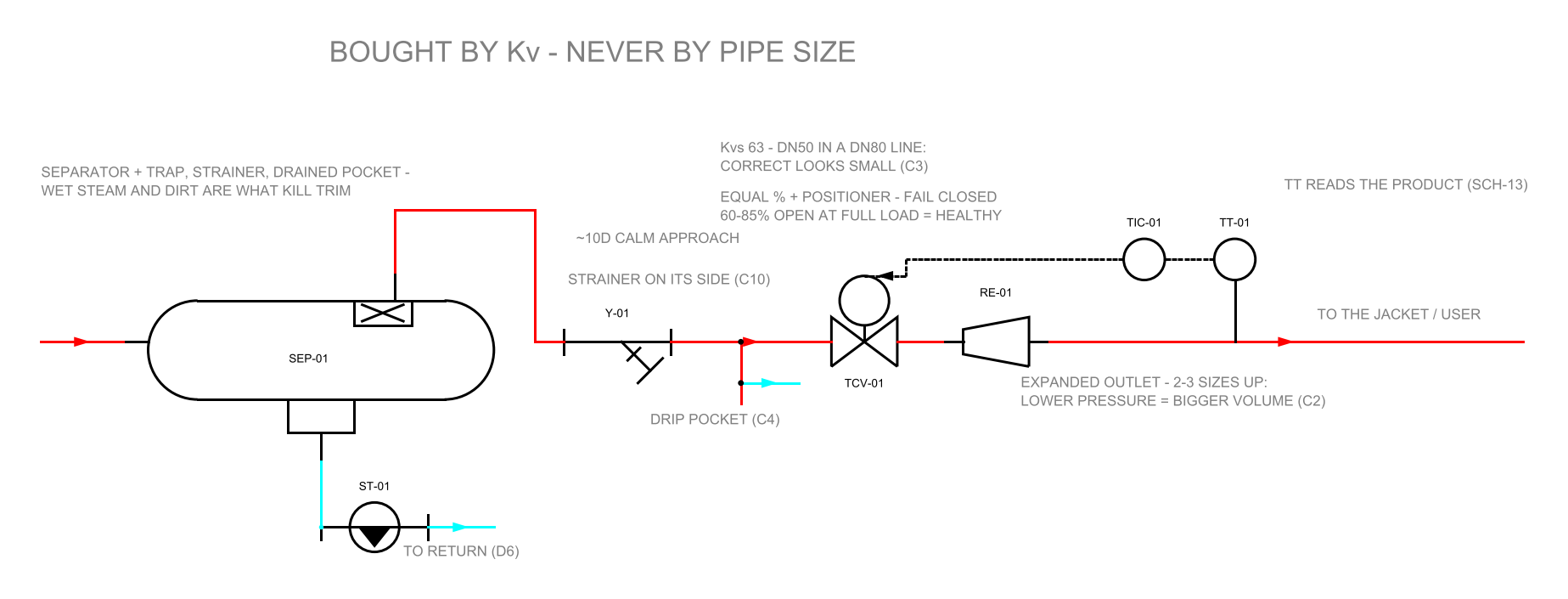
3. Select: next standard body, Kvs 63 — running at ~72% of capacity at
peak, which is healthy (a valve sized to run at 95% has no reserve; one at 30% controls
on the bottom of its travel).
4. Sanity-check the turndown: holding load ~70 kg/h needs Kv ≈ 4.2 —
7% of Kvs. A 15:1 working range is real work: it demands an equal-percentage
characteristic and a good positioner, and it is the argument for not adding "just in
case" margin — at Kvs 100 the same holding load sits at 4% of travel, where no valve
controls well. Note the DN: a Kvs-63 globe valve is typically DN50 — smaller than
the line. Correct looks small (lesson C3's rule, again).
Characteristic and actuator
Characteristic — how Kv grows with travel. Equal percentage (each increment of travel multiplies flow by the same factor) is the default for temperature control: it is gentle at small openings, and its rising gain neatly offsets the falling process gain as a heater approaches temperature. Linear trim suits pressure control and duties holding near one flow. Actuator — overwhelmingly the pneumatic diaphragm, with a positioner (which turns the controller's signal into an enforced valve position, defeating friction and pressure forces) now standard rather than optional. Choose the failure action deliberately: heating duties fail closed (air failure stops the heat — safe), while some duties (a boiler feed valve) must fail open. Say it on the datasheet; it is the one specification nobody can infer later.
Installing it right
A correctly sized valve can still be ruined by its pipework. Four rules cover the installation. Calm approach: give the trim flow, not turbulence — roughly ten pipe diameters of straight pipe upstream, and more before the next downstream bend; a valve bolted hard against an elbow controls the eddy, not the process. Orientation: in a horizontal line, actuator upright, with room to swing a spanner and read the positioner — a valve nobody can reach is a valve nobody maintains. An expanded outlet: the steam leaving is at lower pressure and much larger volume than the steam entering, so the downstream pipework steps up two to three sizes (run lesson C2's arithmetic on the outlet condition and it says so itself). Protection upstream: a separator, a strainer and a drained drip pocket ahead of the valve (lessons C4, C10) — wet steam and pipe dirt are what actually kill trim, wiredrawing and scoring seats long before the stem wears.
And one piece of vocabulary the industry muddles: rangeability is the valve's own controllable ratio — maximum controllable Kv over minimum, measured on a test stand; typical bands run from ~20:1 for self-acting regulators through ~30–50:1 for good globe trim, higher for rotary designs. Turndown is what the installed system achieves with its real pressures and its real margin stack — and it is always less. Catalogues quote rangeability; your process lives on turndown. Confusing the two is how a "50:1 valve" ends up hunting at simmer (the casebook below).
When control goes wrong: hunting, oversizing, turndown
The Clinic's casebook says most "control problems" on steam heating are sizing problems wearing a controller's clothes. Three patterns cover nearly all of them.
Hunting from oversize. The margin stack is the culprit: a consumption estimate rounded up (lesson A10), a safety factor on the Kv, then "make it line size to save a reducer" — and Kv 45 has quietly become Kvs 160. The valve now does all its real work in the first few percent of travel, where trim resolution and friction are worst; the loop overshoots, corrects, overshoots — a slow see-saw a retune cannot cure, because the instrument tech is being asked to control with the first millimetre of a large valve's stroke. The test costs nothing: read the valve position at steady full load. Healthy is 60–85% open; a valve loafing below ~20% is oversized trim, and the cure is a smaller Kvs or reduced trim, not another tuning visit.
Turndown the trim cannot reach. A jacket that sears at full rate but must simmer between batches may ask for a 40:1 flow range; real globe trim manages perhaps 30–50:1 from a healthy middle of its stroke — and far less when oversized as above. When the duty genuinely spans that far, split it: two valves in parallel, a one-third and a two-thirds, sequenced so the small valve handles the simmer alone. One oversized valve pretending to be both is how batch plants buy their hunting.
The trap blamed for the valve. Every modulating steam valve drags its space pressure down at part load — which is lesson D1's stall arriving on schedule, with its flooding, hammer and see-sawing product temperature. The operators' folk remedies — pinching the trap's isolation valve, cracking the bypass — each create the next fault (lessons G3 and G4 price them). Read the sequence correctly: valve throttles → pressure falls → differential dies → drainage stops. The cure sits under the trap (a pumping trap, lesson G3), never in the controller, and not in a "bigger trap" either. If the loop also measures slowly — a thermowell in a dead corner adds its own lag to every correction — fix the sensor's position before touching one tuning constant.
- Size from duty, never from pipe: Kv from the formulas, next Kvs up, and expect a body one or two DN below the line.
- A hunting temperature loop on a valve that runs below ~10% travel is oversized trim, not bad tuning. Check the running Kv before touching the controller.
- Always run the critical check — a valve that has gone choked at low load behaves differently than its sub-critical sizing predicts.
- Record fail action, Kvs, characteristic and positioner on the equipment card; these four facts save every future troubleshooting visit an hour.
- Walk the installation: straight approach, actuator upright and reachable, outlet stepped up 2–3 sizes, separator + strainer + drip pocket upstream. Any miss shows up later as "mysterious" trim wear or hunting.
- Sub-critical: ṁ ≈ 12·Kv·√(ΔP·P₂). Choked (P₂ ≤ 0.58 P₁): ṁ ≈ 6·Kv·P₁ — downstream stops mattering.
- Select the next Kvs above requirement; healthy valves peak at 70–85% capacity.
- Equal percentage for temperature, linear for pressure; positioner always.
- The practice plant's 760 kg/h duty: Kv 45 → Kvs 63 → DN50 body in a DN80 line. Correct looks small.
- Fail action is a decision, not a default — write it down.
The equal-percentage characteristic was not derived — it was carved. Early valve-makers filed and tested plug profiles until temperature loops stopped hunting, and only later did control theory explain why the survivors all shared the same exponential shape: their rising gain cancels a heat exchanger's falling one, leaving the loop with roughly constant gain across the load range. It stands among engineering's happiest accidents — a control-theory theorem discovered by patient men with files, decades before anyone could write it down.
FAQ
Why is my new control valve smaller than the pipe it sits in?
Because it was sized from the duty, not the pipe — which is correct. The practice plant's 760 kg/h jacket works out to Kv 45, a Kvs-63 body, typically DN50 in a DN80 line. A valve bought "line size to save a reducer" ends up controlling on the first few percent of its travel, which is where hunting is born. Correct looks small.
My temperature loop hunts. Should we get the controller retuned?
Read the valve position at steady full load first — it costs nothing. Healthy is 60–85% open; a valve loafing below about 20% is oversized trim, and no tuning visit can cure that, because the tech is being asked to control with the first millimetre of a large valve's stroke. The fix is a smaller Kvs or reduced trim.
What does "choked" or critical flow actually mean?
Drop the downstream pressure below about 58% of the upstream (absolute) and steam reaches the speed of sound in the valve throat. From there, lowering downstream pressure changes nothing — capacity depends on upstream pressure alone, ṁ ≈ 6 · Kv · P₁. It is why deep-cut pressure-reducing valves roar (C3) and why a bigger downstream pipe cannot "help" a venting valve.
Equal percentage or linear — which trim for steam heating?
Equal percentage for temperature control: it is gentle at small openings, and its rising gain offsets the heater's falling gain, so the loop keeps roughly constant gain across the load range. Linear suits pressure control and duties that hold near one flow. Either way, specify a positioner — it is standard now, not optional.
What failure action should a steam heating valve have?
Heating duties normally fail closed — air failure stops the heat, which is the safe direction. But it is a decision, not a default: a boiler feed valve must fail open. Write the fail action on the datasheet and the equipment card; it is the one specification nobody can infer later.
Check yourself
Five quick questions on this lesson. No marks, no records — the score is for you.