
Every other device in this Academy manages steam. The safety valve exists for the day they all fail — the one component whose entire career is a closed valve, waiting. Because it does nothing for years, it is the most neglected fitting in industry; because of what it does in its one working minute, it is the most regulated. This lesson gives the working engineer the vocabulary, the sizing logic, and the installation rules that keep the last line of defence honest.
What it is, precisely
A safety valve is a self-acting pressure relief device: a disc held on a seat by a calibrated spring, needing no power, no signal, no operator — pressure alone lifts it. On compressible fluids (steam, air) the design pops: a shroud around the disc catches the escaping flow and snaps the valve to full lift at once, dumping full capacity immediately rather than dribbling. It answers to physics only; that is the whole point, and why lesson B8's rule — no gags, no washers, no "adjustment" — is absolute.
The vocabulary that prevents arguments
Set pressure — where the valve starts to open; at or below the protected system's design pressure. Overpressure — the rise above set needed to reach full lift, typically up to 10%; the valve delivers its rated capacity at set-plus-overpressure, not at set. Blowdown — how far pressure must fall below set before reseating, also typically several percent; it exists so the valve closes decisively instead of chattering on its seat. Chatter — rapid open-close cycling — is the destructive failure mode: it hammers the seat to leakage in minutes and usually traces to an oversized valve or a starved inlet line (below). Working headroom follows: the normal operating pressure should sit at least ~10% below set, or the valve lives forever on the edge of simmering — the practice plant's boiler runs 10.5 kg/cm²g against safety valves set at its 11.5 design, and that gap is why they seal.
Sizing: capacity for the worst credible flow
A safety valve is sized to discharge the maximum flow the failure case can generate, at set-plus-overpressure, so system pressure can rise no further. The two everyday cases: a boiler — combined SV capacity at least the maximum continuous evaporation with the fire at full output (lesson B8; IBR demands two valves and the arithmetic); downstream of a PRV — the failed-wide-open valve, computed from lesson D3's critical formula at upstream pressure (ṁ ≈ 6 · Kvs · P₁ — choked flow, so the downstream pressure is no help), which is almost always several times the normal duty. This is lesson C3's warning made arithmetic: the LP system's safety valve is sized for the PRV's Kvs, not for the process load — and a "safety valve that fit the flange" protects nothing but the invoice. Undersizing is failure; gross oversizing buys chatter. Vendors size from the standards' certified capacity tables — your job is handing them the honest failure flow.
Installation: where good valves are ruined
The valve stands directly on the protected system — no isolation valve may stand between them (IBR and common sense agree; a locked-open gate is for maintenance regimes that formally control it). The inlet is short and full-bore: a long or throttled inlet drops pressure under discharge flow, the valve senses the dip, reseats, senses pressure, lifts — chatter, by installation. The discharge pipe is at least valve-outlet bore, routed to a safe visible point, independently supported (its reaction thrust and weight must never load the valve body), and drained at its low point — a discharge stack full of rainwater is a slug waiting for the first lift (lesson C5) and a corrosion cell the rest of the year. And the humble easing lever stays functional: lesson B8's scheduled hand-lift is the only routine proof that the disc is not rusted to its seat.
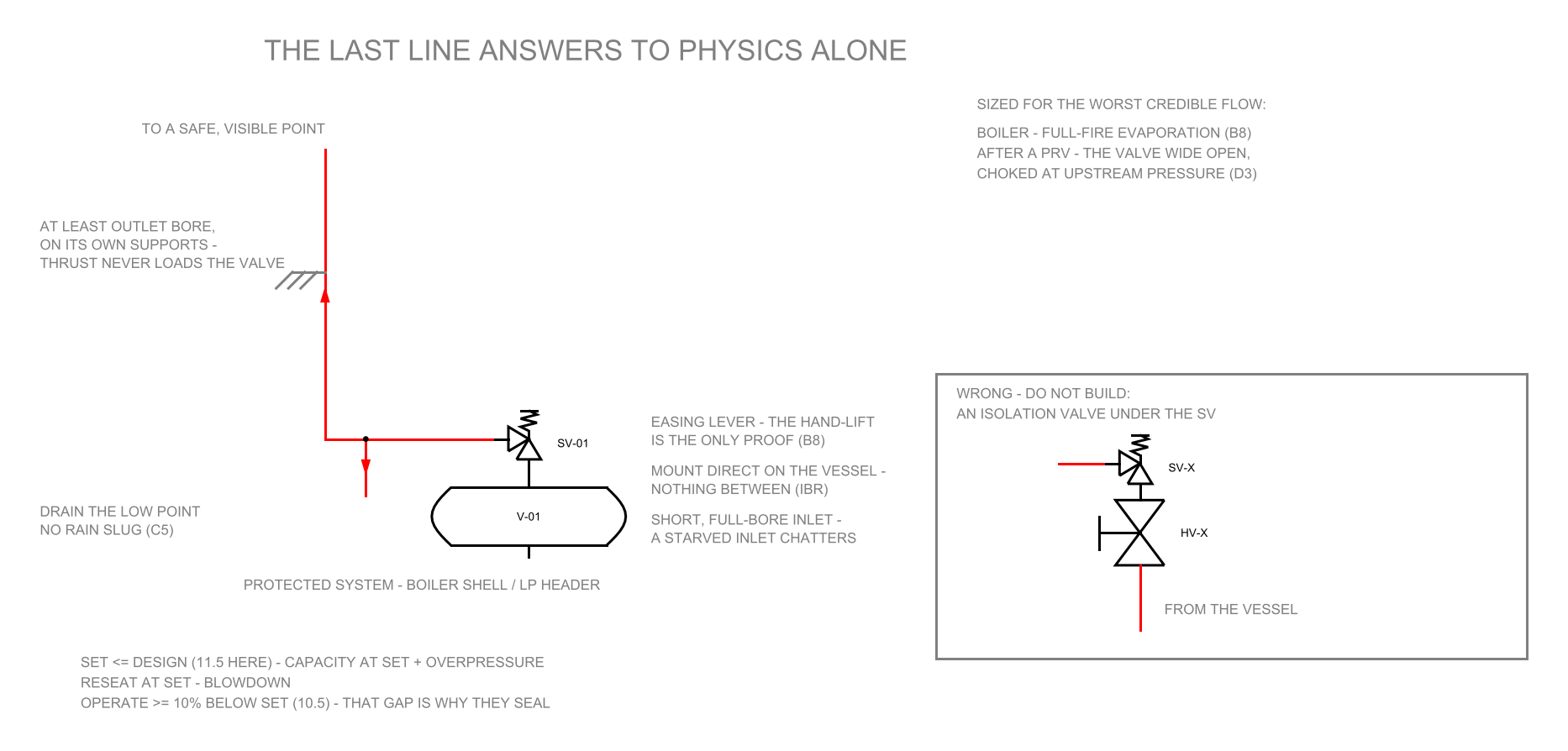
- Walk every SV: anything between it and the vessel? discharge supported and drained? easing lever present and used per the log?
- Check the headroom: operating within ~10% of set = weeping, wire-drawn seats and "the SV always leaks" folklore. Fix the operating pressure or the set, formally.
- Every PRS: ask for the downstream SV's sizing basis in writing. "PRV failed open at upstream pressure" is the only correct answer (lessons C3, D3).
- A simmering or chattering valve is condition information — inlet geometry, oversize, or headroom. Diagnose; never gag.
- Self-acting, spring-loaded, pops to full lift — the last line answers to physics alone.
- Set ≤ design; capacity rated at set + overpressure; reseat at set − blowdown; operate ≥10% below set.
- Size for the worst credible flow: full-fire evaporation, or the PRV wide open on choked flow.
- Nothing between valve and vessel; discharge supported, safe, drained.
- Tested by the calendar (B8), certified per IBR (B10), adjusted by nobody.
Denis Papin fitted the first recorded safety valve to his "steam digester" — a pressure cooker — in 1679, holding the disc down with a weight on a lever. For two centuries the lever-and-weight ruled, with a fatal flaw: a weight can be quietly slid outward, and engine-men chasing performance did exactly that, contributing to the nineteenth century's grim boiler-explosion statistics. The enclosed, spring-loaded, tamper-evident safety valve — and the inspector who seals it — is the direct institutional memory of those accidents. The lesson has not changed in three hundred years: the last line of defence must be harder to defeat than the temptation to defeat it.
FAQ
Why does our safety valve keep weeping?
Check the headroom before blaming the valve. A system operating within about 10% of the set pressure keeps its valve forever on the edge of simmering — the seat wire-draws, and "the SV always leaks" becomes plant folklore. The practice plant runs 10.5 kg/cm²g against valves set at 11.5, and that gap is why they seal. Fix the operating pressure or the set point, formally — never the spring.
Can there be an isolation valve under a safety valve?
No — the safety valve stands directly on the protected system, with nothing between them. IBR and common sense agree. The one exception is a locked-open gate under a maintenance regime that formally controls the key, which is a discipline, not a convenience. Anything less turns the last line of defence into a hope.
How is the safety valve after a pressure-reducing station sized?
For the PRV failed wide open at upstream pressure — choked flow, ṁ ≈ 6 · Kvs · P₁, which is almost always several times the normal process duty. Ask for the sizing basis in writing on every PRS; "sized for the process load" or "it fit the flange" are the wrong answers, and D3's critical formula is the check.
What is chatter, and what causes it?
Rapid open-close cycling that hammers the seat to leakage within minutes. It traces to a grossly oversized valve, or to a long or throttled inlet that starves the valve under discharge flow — it senses the dip, reseats, senses pressure, lifts again. Chatter is condition information: diagnose the inlet geometry, the size and the headroom. Never gag the valve.
Why must the discharge pipe be drained and separately supported?
An undrained stack fills with rainwater — a slug sitting on the valve outlet, waiting for the first lift to become a hammer blow, and a corrosion cell every other day of the year. And the discharge line's weight and reaction thrust must land on its own supports, never on the valve body, or the valve you tested is not the valve you have.
Check yourself
Five quick questions on this lesson. No marks, no records — the score is for you.