
Indirect heating pays a wall-crossing tax: films, fouling, stall, and a quarter of the energy left in the condensate. Direct steam injection (DSI) skips the wall — steam meets the product, condenses in it, and delivers every kilocalorie it carries, sensible heat included. One hundred percent thermal delivery, instant response, almost no equipment. The price is written in three currencies — dilution, noise, and hygiene — and this lesson prices all three.
Where DSI naturally wins
Heating water and water-like products where added water is welcome or harmless: hot-water tanks and mixing duties, starch slurry cooking (the jet cooker is DSI perfected), pulp and effluent streams, CIP liquor, jacketed-vessel alternatives in sugar and food processes, and every duty of the humble sparge pipe. Response is DSI's party trick — there is no wall to warm, so temperature answers the valve in seconds, which control engineers love (lesson D3's loops get easy). And because delivery is total, DSI is the thermodynamic ceiling: 664 kcal per kilogram at the practice plant, against the ~476 an indirect surface hands over before sending the condensate home.
The three prices
Dilution. Condensed steam stays in the product — about 13 kg of water per 100 L raised 70 °C. Fine in a mixing tank; a defect in anything where concentration matters; a gift in processes that wanted the water anyway. Do this arithmetic first, because it disqualifies DSI faster than any other line. The water bill. That condensate never returns to the boiler — lesson D6's three values (water, heat, treatment) are all forfeited, and the make-up burden of lesson B6 grows. DSI's "100% efficiency" is real at the point of use and partly clawed back at the feed tank; honest comparisons price both ends. Noise and hammer. Steam bubbles collapsing in cooler liquid is lesson C5's thermal-shock mechanism, miniaturised — a badly sparged tank rattles like a kettle drum and erodes its own pipework. The fix is engineering, not tolerance: proper distributors and injection heaters, below.
From sparge pipe to silent heater
The sparge pipe — a capped tube with drilled holes, submerged in the tank — is DSI at its cheapest, and fine for occasional, unattended duties if the holes point down or sideways (never up at the surface), the pipe stays fully submerged, and a check valve guards against the tank siphoning back on shutdown (lesson C10). The injection heater is the engineered version: a nozzle assembly that meters steam through many small orifices into the moving liquid, collapsing the bubbles in controlled shear — quiet, vibration-free, and controllable across the whole load range. In-line variants heat flowing product in one pass through a mixing throat (the jet cooker's geometry). Selection is by duty and turndown, from catalogue data; the physics to respect is that quiet DSI = many small bubbles collapsing in moving liquid, and every silent heater on the market is a different way of buying that.
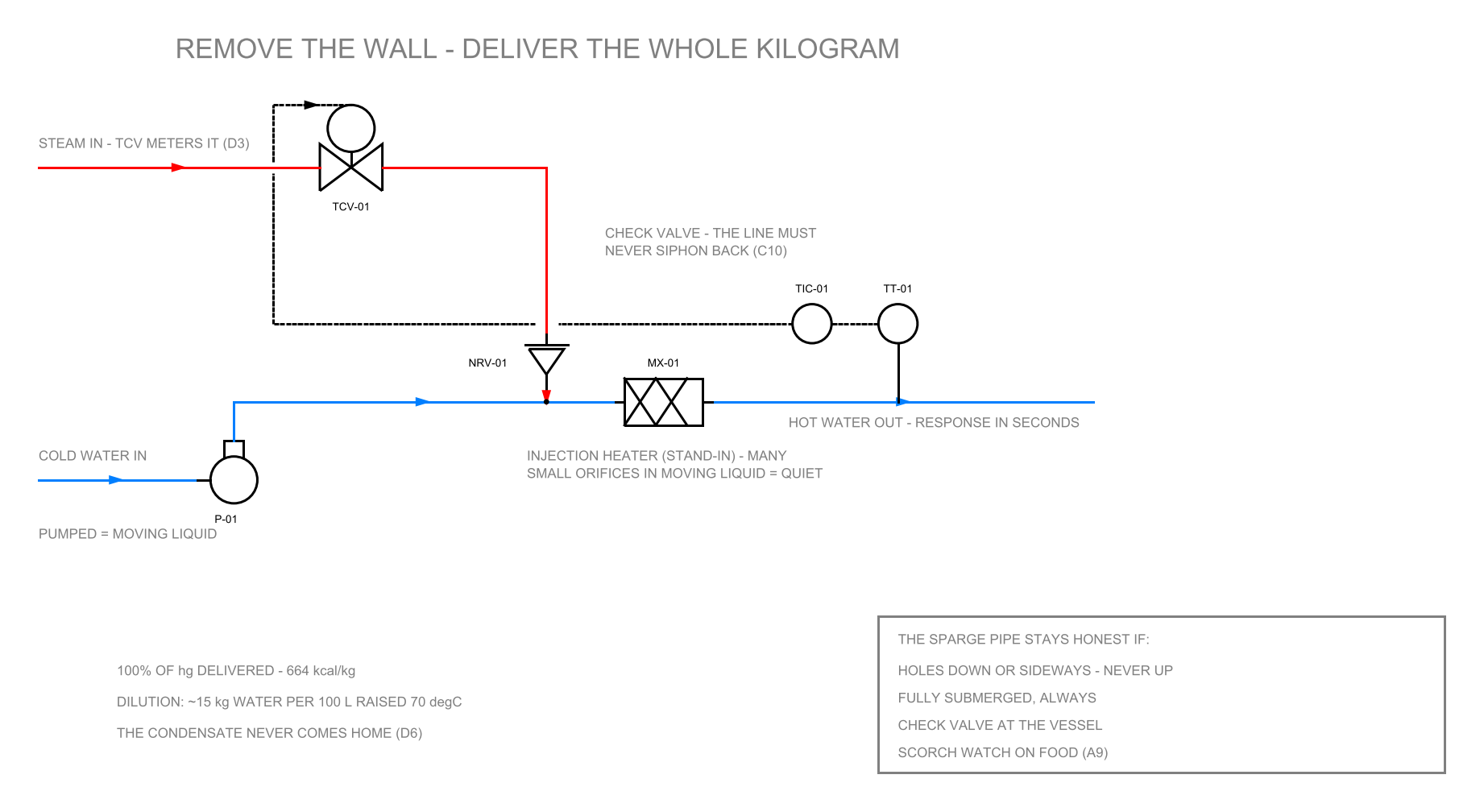
Culinary duty: when steam touches food
DSI into food or pharma product makes the steam an ingredient — lesson A9's grades stop being theory: culinary (filtered) steam minimum, food-safe boiler chemistry verified, the filter maintained and on record, and clean steam where the specification says sterile. The process side must also tolerate the local hot spot at the injection point — protein products scorch at the nozzle if the mixing is lazy, which is another argument for engineered injection over a drilled pipe.
- Run the dilution sum before anything else: kg steam = duty ÷ ~540. If the added water hurts, stop here — indirect heating (D1) or a PHWG (D9) is your lesson.
- A rattling DSI tank is telling you bubble collapse is uncontrolled: check submergence and hole direction today, budget an injection heater this year.
- Every DSI line gets a check valve at the vessel — product siphoned back up a steam line is a boiler-chemistry incident (B7) waiting downstream.
- Food product? Paperwork first: chemical list, filter spec, maintenance record. The auditor will ask in exactly that order.
- DSI delivers the whole kilogram — hg, not just hfg — with instant response and almost no equipment.
- The three prices: dilution (~13 kg water per 100 L·70 °C), forfeited condensate, and hammer if unengineered.
- Quiet DSI = many small bubbles in moving liquid. That is what an injection heater sells.
- Steam that touches food is an ingredient — culinary grade and its paper trail apply.
The starch industry's jet cooker is DSI's masterpiece: cooking starch slurry demands precise temperature held through a violent viscosity peak, and every indirect surface ever tried fouled with cooked starch in hours. The jet cooker — steam injected into slurry rushing through a mixing throat — cooks in seconds, fouls nothing (there is no hot wall to bake onto), and holds temperature to a fraction of a degree. It is the clean statement of this lesson: when the wall is the problem, remove the wall.
FAQ
How much water does direct steam injection add to my product?
Roughly 13 kg of water for every 100 L raised 70 °C — the condensed steam stays in the product. Estimate it as kg steam = duty in kcal ÷ ~540, and run this sum before any other DSI arithmetic: if the added water hurts the product, DSI is disqualified and indirect heating (D1) or a hot-water loop is your answer.
Why does my steam-sparged tank bang like a kettle drum?
Large steam bubbles are collapsing violently in still, cooler liquid — water hammer's thermal-shock mechanism, miniaturised and repeating. Check today that the sparge holes point down or sideways and the pipe is fully submerged; budget an injection heater for a permanent cure, because quiet DSI means many small bubbles collapsing in moving liquid.
Is DSI really 100% efficient?
At the point of use, yes — the product receives everything the steam carries, sensible heat included: about 664 kcal/kg at the practice plant against the ~476 an indirect surface hands over. But the condensate never returns to the boiler, so the water, its remaining heat and its treatment value are all forfeited (D6). Honest comparisons price both ends.
Can I inject steam directly into a food product?
Only as an ingredient — because that is what the steam becomes. Culinary (filtered) steam is the minimum, the boiler chemical list must be food-safe and verified, the filter maintained on record, and clean steam used where the specification says sterile. Watch the injection point too: lazy mixing scorches protein products at the nozzle.
Do I really need a check valve on a sparge line?
Yes, at the vessel — non-negotiable. When the steam is shut off, the collapsing vapour in the line pulls vacuum and the tank contents siphon back up the steam pipe, heading for places product must never go. A stuck or missing check valve here is a boiler-chemistry incident in the making.
Check yourself
Five quick questions on this lesson. No marks, no records — the score is for you.