
Everything so far delivered steam to the process door. This faculty walks through it — and the first room is indirect heating: coils, jackets and shell-and-tube exchangers, where steam gives up its latent heat across a wall (lessons A6 and A11 built the theory; this lesson runs the equipment). It ends with the stall phenomenon — the single most misdiagnosed fault in steam heating, responsible for more "bad trap" accusations than every actual bad trap combined.
Choosing the surface
Jackets wrap the vessel — simple, cleanable on the product side, modest in area (the practice plant's 10 m² jacket from lesson A11 is typical), which caps their heating speed. Coils put the surface inside the product: several times the area of a jacket in the same vessel, faster response, at the price of cleaning access and a wetted obstruction. Shell-and-tube exchangers heat flowing product in-line — steam in the shell, product in tubes — compact and continuous (lesson D13 walks the inside of one, specifier's questions included); their close cousin, the plate heat exchanger, trades higher performance for gasket temperature limits. The selection logic runs on lesson A11's equation: the duty needs U × A × LMTD, and each geometry offers a different bargain of area, U and cleanability. What never changes: the steam side must shed condensate and air continuously, or the surface you paid for stops being steam-heated surface.
Piping the steam side right
Every indirect heater follows one pattern: steam enters at the top of the space (steam is lighter than the condensate it becomes; top entry lets the space fill downward), condensate leaves at the bottom lowest point through its trap (lesson D5), and the air vent sits far-top-corner (lesson C8). A control valve meters steam in response to product temperature (lesson D3). Simple — and behind that simplicity waits the trap-drainage problem this lesson exists to explain.
Stall: when the pressure disappears
A trap passes condensate on pressure difference: space pressure minus return pressure. Here is what the control valve does to that difference. On a mild day, light load: the valve throttles down, and the pressure in the jacket falls — that is how temperature control works, because lower pressure means lower saturation temperature (lesson A3, run backwards). Throttle far enough and the space pressure drops to — and below — the pressure in the condensate return line. The differential across the trap reaches zero. The condensate stops leaving — not because the trap failed, but because nothing pushes it. That is stall. The condensate backs up into the jacket, drowning heating surface; temperature control goes sluggish, then cyclic — the drowned surface under-heats, the controller opens the valve, pressure returns and slams the backed-up condensate out, the surface over-heats, the valve closes, and the cycle repeats. Symptoms at site: hammering in the equipment at part load (lesson C5's thermal shock, made hourly), rusty streaked condensate (waterlogged surfaces corrode), product temperature see-sawing at exactly the loads where everything should be gentle.
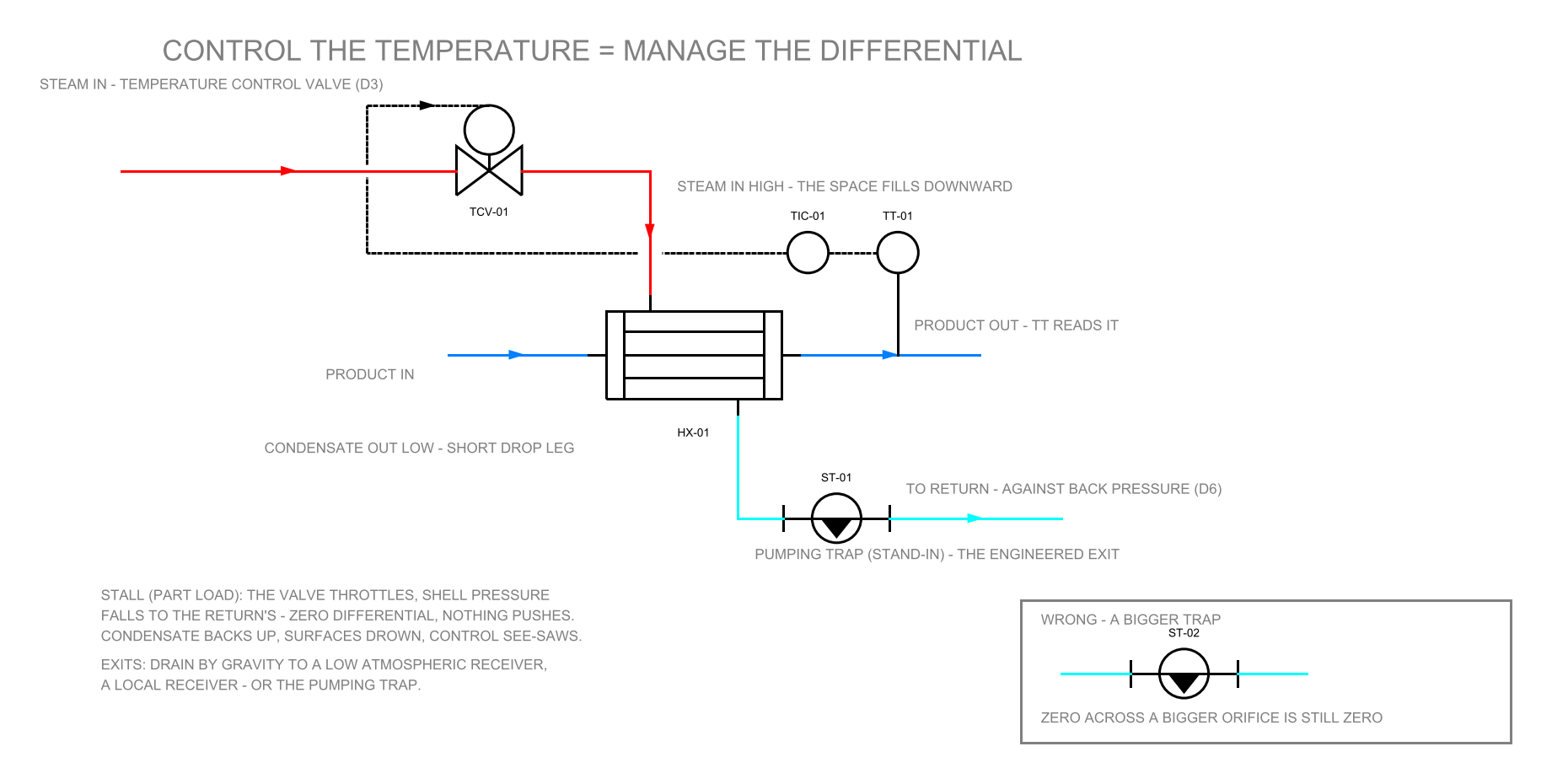
Getting out of stall
Three honest exits, in rising order of cost. Drain by gravity to atmosphere: if the trap can discharge to an atmospheric receiver below the equipment, the differential never quite dies — the classic fix for stand-alone vessels, at the price of pumping the condensate onward (lesson D6). Lift the back pressure problem away: re-route the trap discharge out of a high, flooded or pressurised common return into a local low-level receiver. The pumping trap: a trap combined with a small steam-powered pump in one body — drains normally when differential exists, pumps when it doesn't. The engineered answer for temperature-controlled equipment that lives at part load, and the standard end to the see-saw story above. What is never the answer: a bigger trap. Zero differential across a bigger orifice is still zero.
- Any temperature-controlled steam equipment that hammers or hunts at part load: suspect stall before the trap. Check the space pressure at light load against the return pressure — two gauges settle it.
- Sketch the stall chart for your equipment once: design pressure, return pressure, load range. The crossing tells you whether you need the pumping trap now or never.
- Steam in at top, trap at true bottom, vent far corner — walk each heater against the pattern; retrofit plumbing sins are cheap to fix cold.
- Rusty condensate from one heater = waterlogging there. Follow it back before it becomes tube failure.
- Indirect heating = A11's equation with plumbing: area × U × LMTD, kept drained and vented.
- Temperature control works by lowering space pressure — which is exactly what kills trap differential at part load.
- Stall = condensate with nothing pushing it. The trap is innocent; the physics is guilty.
- Exits: gravity to atmosphere, local receiver, or a pumping trap. Never just a bigger trap.
Stall earned its textbook status in the laundry and food industries, where hundreds of small temperature-controlled machines — ironers, kettles, tanks — all ran at part load most of the day. Whole maintenance departments changed traps on a rota, and the hammering continued regardless; the pumping trap, developed in the 1980s–90s precisely for this duty, ended a decades-long argument between operators ("the trap is bad") and vendors ("the trap tests fine") in which both sides were right — the trap was fine, and it wasn't draining. The lesson outlived the laundries: control the temperature, and you have signed up to manage the differential.
FAQ
Why does my jacketed vessel hammer only at part load?
That timing is the signature of stall. At light load the control valve throttles the jacket pressure down to — or below — the condensate return pressure, the trap loses its differential, and condensate backs up. When the controller re-opens the valve, returning steam pressure slams the backed-up water out: hammer, on the hour, only on mild days. Two gauges — space and return — settle the diagnosis. The full clinic is in G3.
Will a bigger steam trap cure slow, see-sawing heating?
Almost never. If the cause is stall, there is no pressure difference pushing condensate through the trap — and zero differential across a bigger orifice is still zero. Before touching the trap, compare space pressure and return pressure at light load; if they cross, the money belongs in drainage (a low-level receiver or a pumping trap), not in trap size.
Coil, jacket or shell-and-tube — how do I choose?
All three are the same equation — duty = U × A × LMTD (A11) — offering different bargains. A jacket is simple and cleanable but modest in area, which caps heating speed. A coil puts several times that area inside the product, faster but harder to clean. Shell-and-tube heats a flowing product continuously in-line. Decide on area, cleanability and whether the duty is batch or continuous.
Where should steam enter a jacket or coil, and where should it leave?
One pattern fits every indirect heater: steam in at the top of the space, condensate out at the true lowest point through its trap, and an air vent at the far top corner. Steam is lighter than the condensate it becomes, so top entry fills the space downward. Walk each heater against this pattern — plumbing sins are cheap to fix cold.
Why is the condensate from one particular heater rusty?
Rusty, streaked condensate from a single heater means its surfaces are spending hours underwater — waterlogging, usually from stall or a drainage fault, corroding the steam side from within. Treat it as an early warning: follow the water back and fix the drainage before it becomes tube or jacket failure.
Check yourself
Five quick questions on this lesson. No marks, no records — the score is for you.